Holly Mason Badra Speaks with Transdisciplinary Artist Mojdeh Rezaeipour About Their Recent and Ongoing Work, “Classroom Solidarties: Jin Jiyan Azadî”
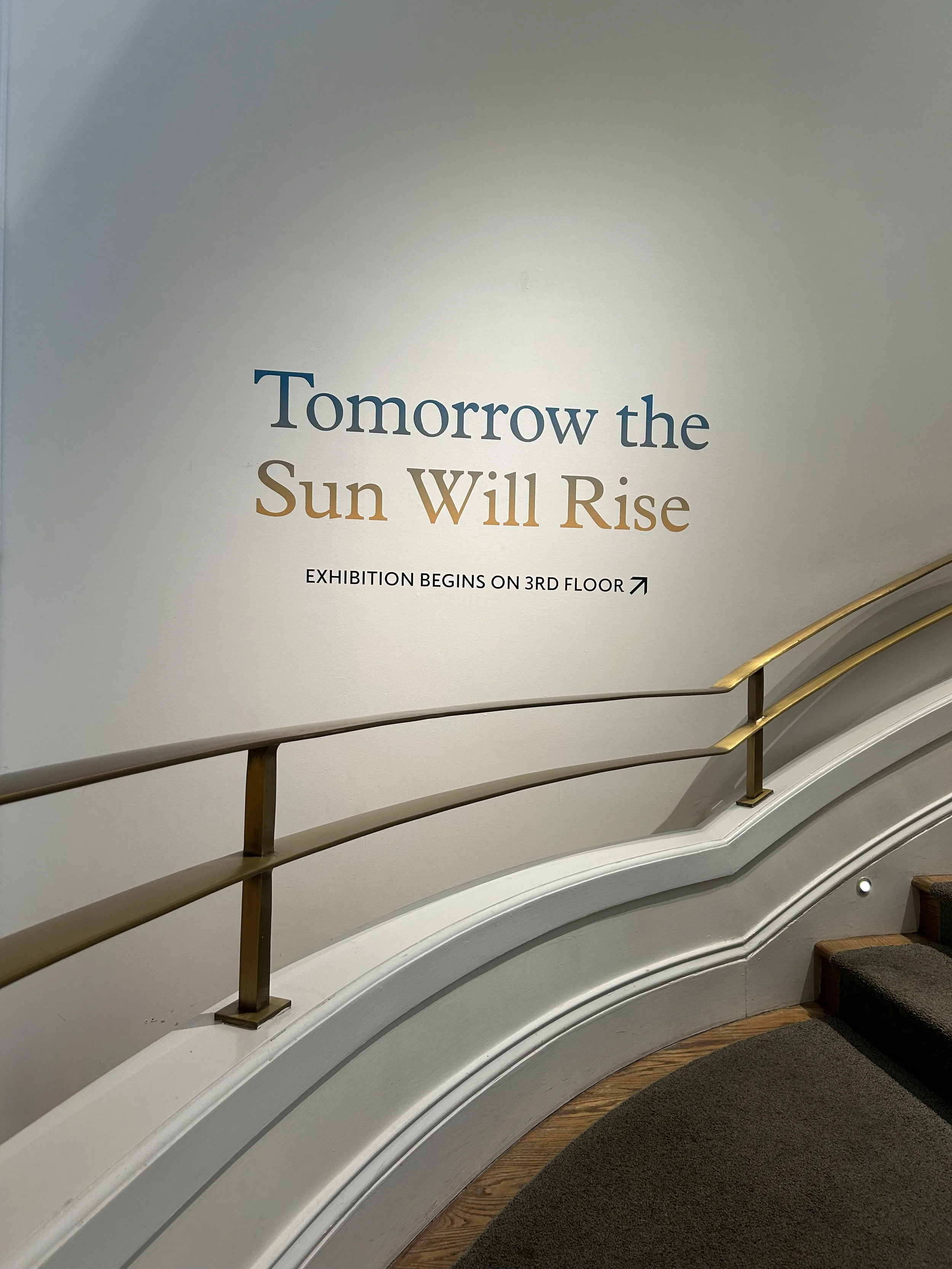
The stairwell leading up to Tomorrow The Sun Will Rise at The Phillips Collection. Image courtesy of Hollly Mason Badra
Tomorrow the Sun Will Rise, showing from August 1st through September 20th, was curated by Tie Jojima, Curator of Global Contemporary Art, The Phillips Collection, and Tsedaye Makonnen, Guest Curator, and features 48 artists from Washington, DC, Maryland, and Virginia.
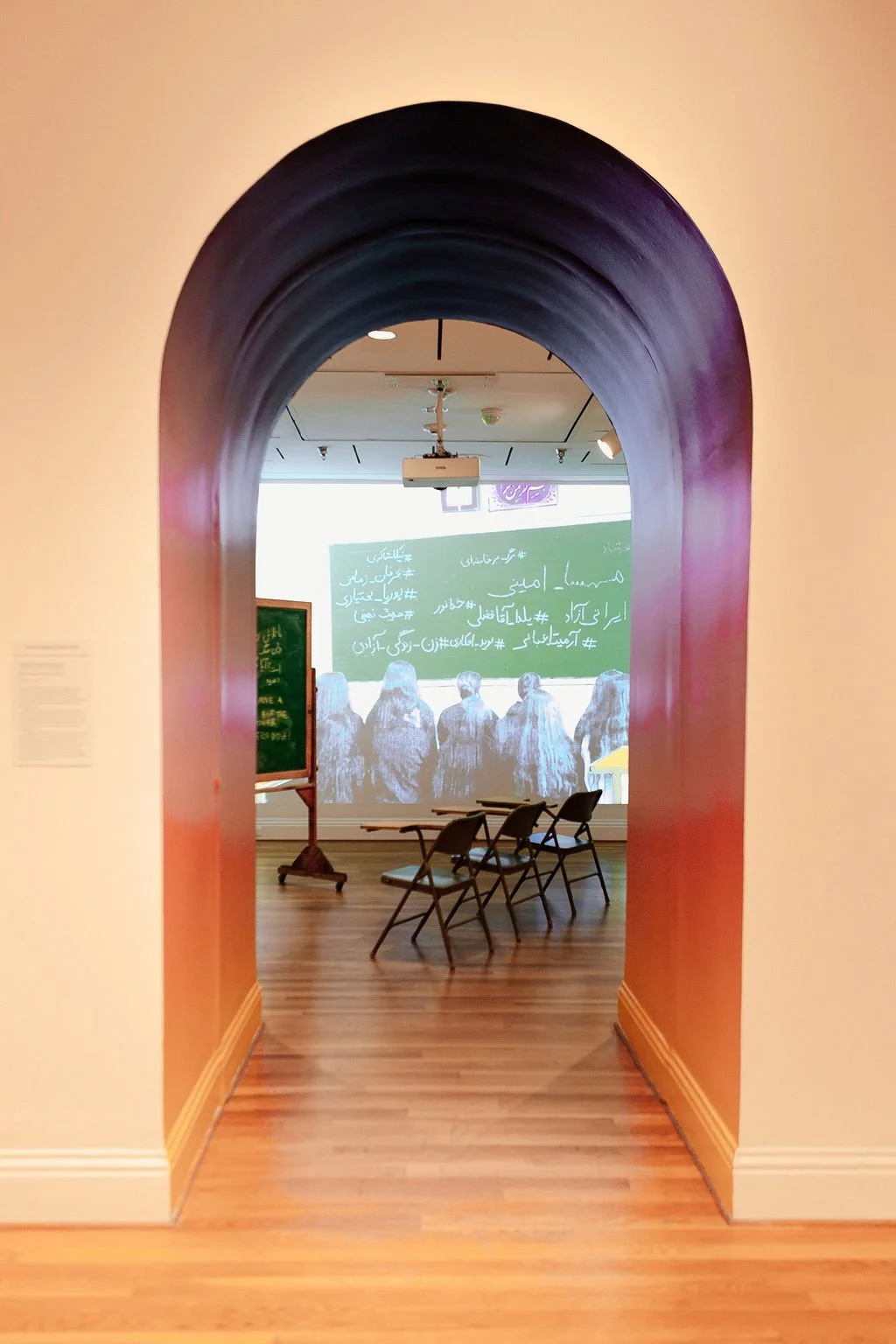
Installation shot from “Classroom Solidarities: Jin Jiyan Azadi” in Tomorrow The Sun Will Rise at The Phillips Collection. Image credit: Senna Ahmad
As soon as I entered the third floor where Tomorrow the Sun Will Rise is on display, I instantly heard the sounds from Classroom Solidarities. I heard the chanting and protesting that reverberates from the analog stop motion film playing within the classroom, and I knew it was their work. I was drawn immediately towards the sound, though a part of me wishes I saved their room for the end, in hindsight. The room featuring Mojdeh’s installation is interactive and immersive. After spending time in that space, looking at the mixed media works on wood on the walls featuring digital protest images of women and young girls in classrooms across Iran and Kurdistan, sitting in the schoolhouse style desk and writing my own response to the prompts, and observing the film featuring multi-lingual audio and text, stop motion animation, still images, and recordings of the artist at work in their studio, I felt like I entered another dimension in which I was invited to sit with questions around state violence and people’s resistance. After being submerged within this experience, exiting the room and walking into the next was disorienting. This feels meaningful and important. Should we exit a space that calls to mind fascist and imperialistic brutality and destruction feeling immediately steadied? I think not. The space also wraps us up within a shawl of witnessing—that is witnessing the power and magnificence of women, of solidarity, of collective action. Given that Iranian and Kurdish women continue to fight for their rights and the rights of all Iranians and Kurds, the Jin Jiyan Azadî movement is ongoing and deeply rooted. These lingering voices, images, and questions should follow us out of the room. Mojdeh’s multi-textural, inter-textual, multi-modal, layered works all together create these echoes.
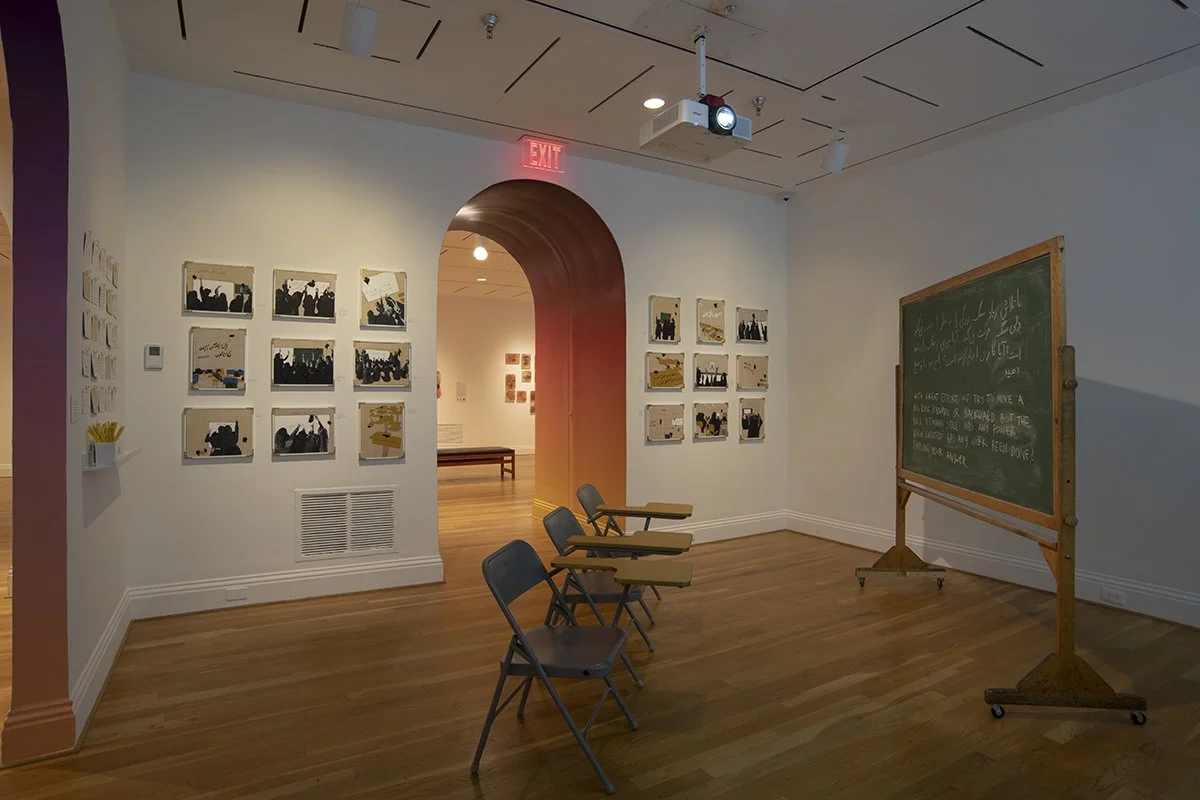
Installation shot from “Classroom Solidarities: Jin Jiyan Azadi” in Tomorrow The Sun Will Rise at The Phillips Collection. Image credit: Lee Stalsworth
Holly Mason Badra: How do you see this installation in conversation with your full body of work overtime?
Mojdeh Rezaeipour: “Classroom Solidarities” is directly rooted in my 2017 series “On Matters of Resilience.” This body of work started as deconstructions and reconstructions of photos taken of me during the first days of elementary school in Iran in the mid-late 1990s under the Islamic Republic. One of the first decisions I made was to remove the faces of my classmates in the work in order to protect their identities. The resulting cutout with just the headscarf uniform startled me as a representation of the day to day oppressions that I had normalized in my childhood. It felt powerful to have revisited and reconstructed this moment when I became divided as a young person, and to have visually separated all of us from this symbol of the state, these forced pieces of cloth. But in a post 9/11 United States, and especially in the era of the first Muslim Ban, I felt I didn’t yet have the nuanced language to talk about this work to avoid feeding into a sort of Islamaphobic rhetoric. For a while I experimented with coding these smaller works as 2D vocabularies in larger installations, and eventually moved on to new bodies of work that were less centered on identity.
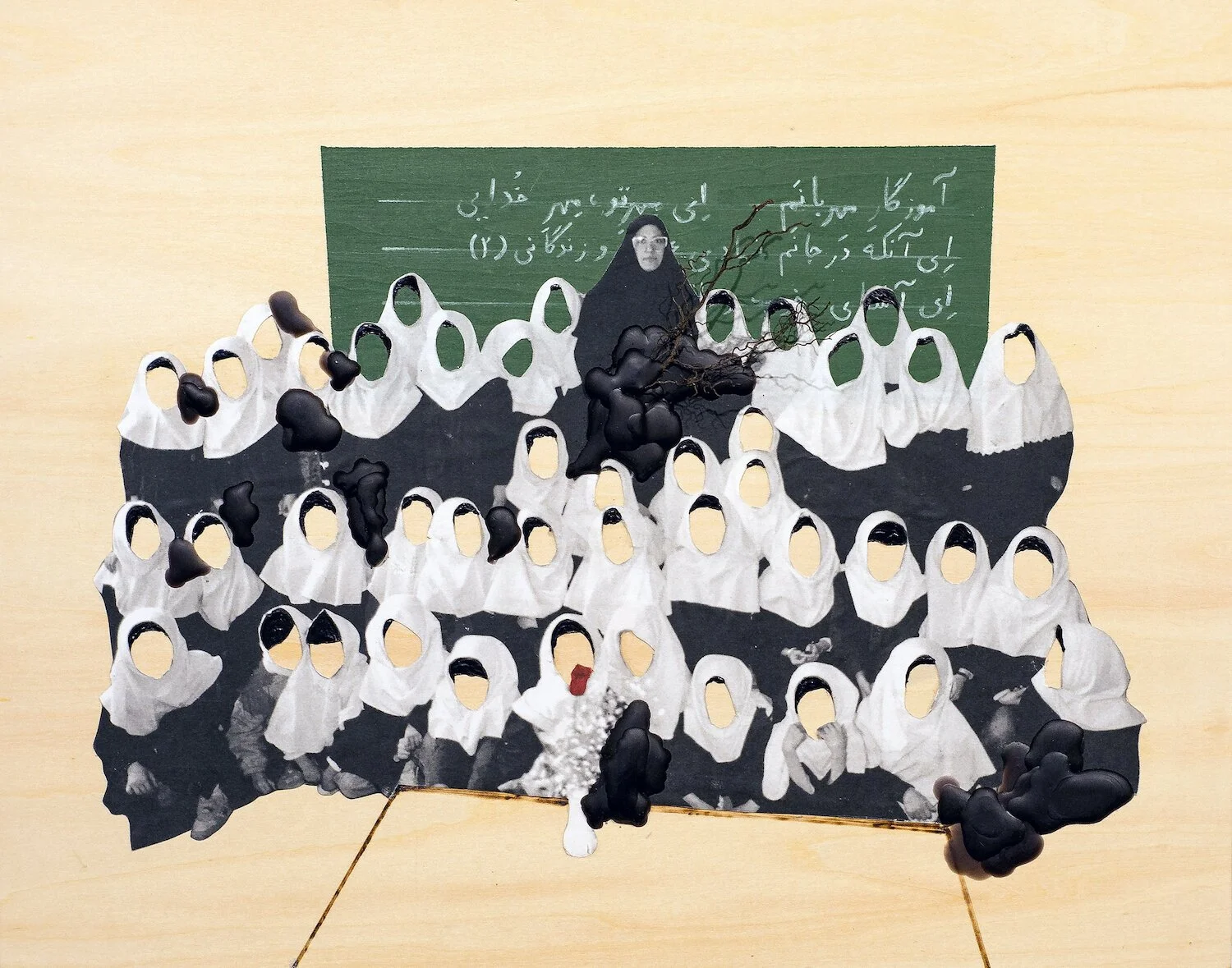
On Matters of Resilience: Teacher (2017). Image courtesy of artist.
MR: On September 16th 2022, the Islamic Republic's 'morality police' murdered 23 year old Kurdish woman Jîna (Mahsa) Amini for the crime of showing a few strands of her hair outside her headscarf while visiting Tehran from Eastern Kurdistan, Saqqez. Protests erupted at her funeral framed by the Kurdish slogan Jin, Jîyan, Azadî (Woman, Life, Freedom) which has decades-long roots in Kurdish liberation movements across the region. Before long, a feminist revolutionary movement began to spread like wildfire on the streets of Iran, most commonly referred to in the farsi translation Zan Zendegî Azadî. In an attempt to process these bold displays of courage and resilience that were primarily being shared in image form, I returned to the studio about a month postpartum, sorting through the material categorically. As a bold response to one of IR’s first fear-mongering tactics of occupying several universities in early October that year, photos started populating on social media of women and young girls posing without their headscarves in classrooms nationwide. These settings - and these group photos - looked eerily similar to the ones I once posed in as a child, and the series of works I had made with these materials in 2017. I wanted to honor the brave youth who were risking their lives to take and to pose in photographs without their mandatory headscarves inside of these classrooms, and to connect all of our stories by bringing the images together in the same visual language.
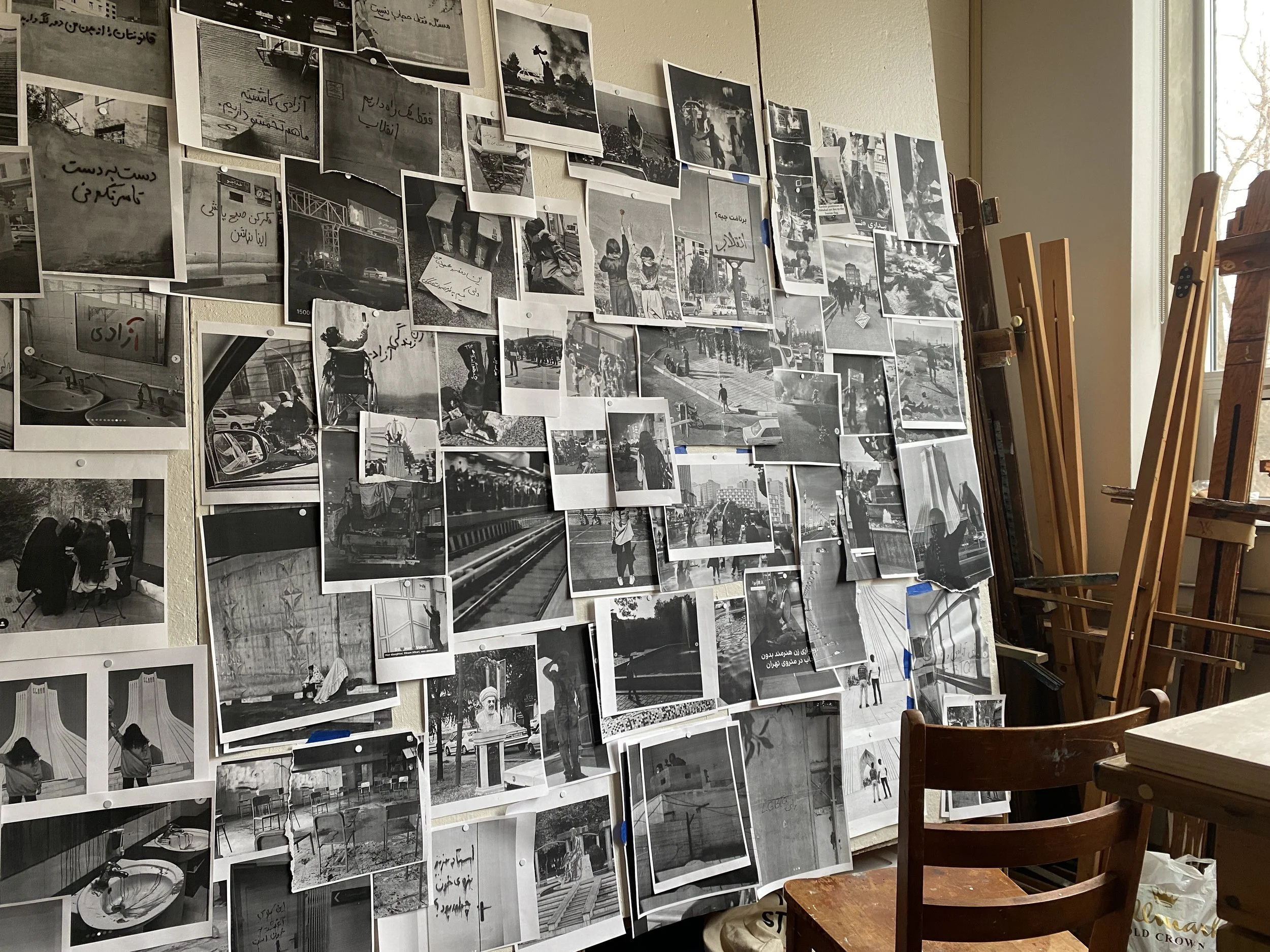
Mojdeh’s studio in December 2022. Image courtesy of artist.
HMB: I remember you mentioning to me when we did our virtual studio visit last year that the beginnings of this work were inspired by Jacob Lawrence’s Migration Series, half of which is in the permanent collection at The Phillips, two floors down from your installation. Can you share more about the ways in which these works inspired you?
MR: From October 2022 onwards, my studio became somewhat of an analog newsroom for images coming out of this iteration of Jin Jiyan Azadî instigated by Jîna’s murder. It was a place for me to process my moment to moment learning of the profound displays of courage, resilience, beauty and power that were digitally etched into many of our psyches as a people. Several categories became apparent: graffiti around the city, images of people dancing by Azadi tower, small acts of community care and solidarity on university campuses, balloons carrying revolutionary slogans, memorials to those who had already been murdered by the state for participating in these acts, and more. I wanted to collect and organize these images away from social media where they tend to be lost and forgotten, and to create a record of them in physical form.
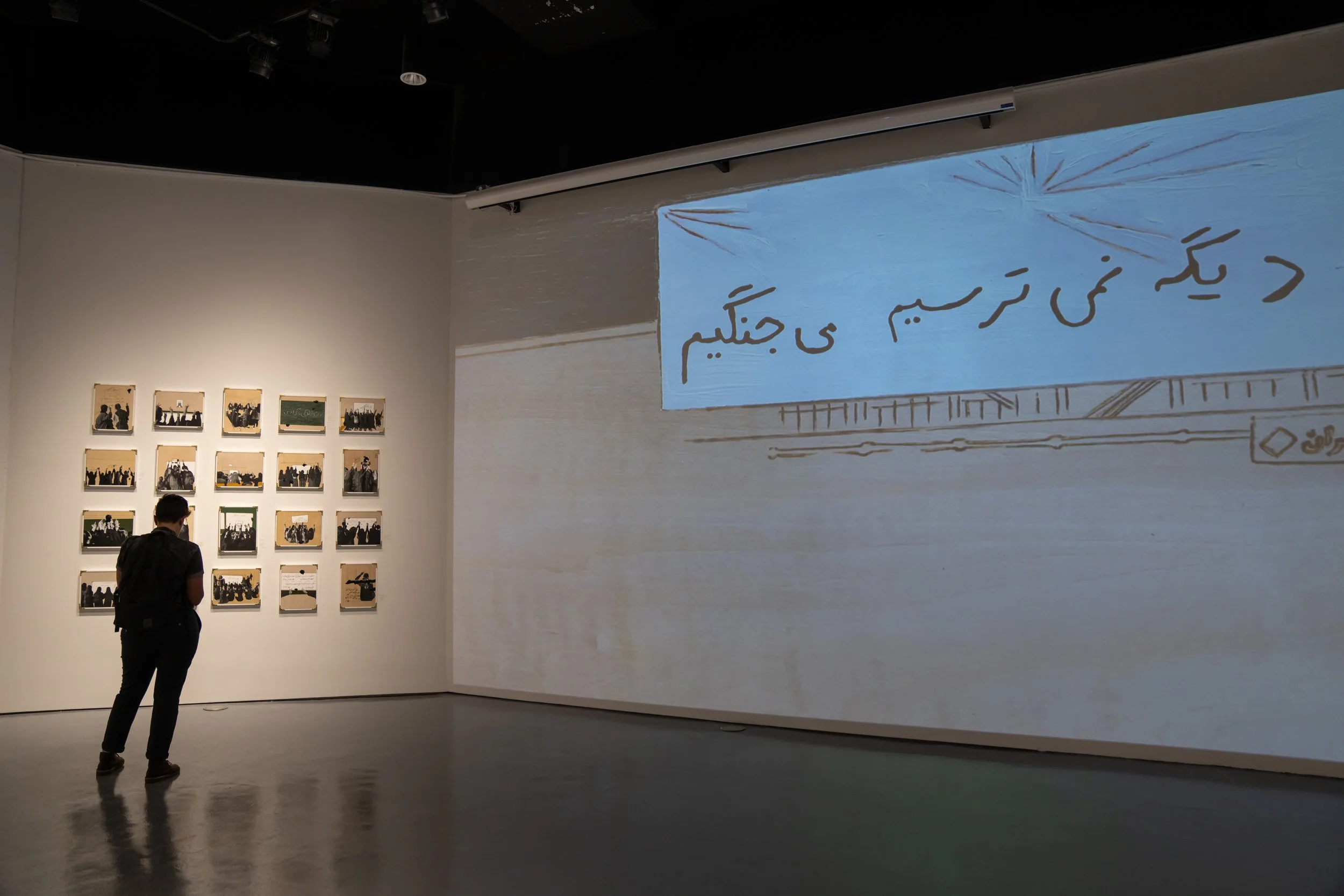
Installation shot from “Classroom Solidarities: Jin Jiyan Azadi” at University of Maryland (2024). Translation: “We are not afraid anymore. We will fight.”, Image credit: Taneen Momeni
MR: I was thinking about Jacob Lawrence and The Migration Series, which is a 60-panel tempera-on-hardboard series, chronicling the movement of Black Americans from the rural South to the urban North. Each panel in the series is accompanied by a sentence from the narrative as a whole, and I imagined similarly telling the story of this revolutionary movement. I remember reading that Lawrence worked on all of the panels at the same time in order to develop a unified color palette between them, and that offered me a certain perspective that allowed me to go slow. Eventually the imagery grew beyond what I could hold, and I decided to focus primarily on the classrooms because they were so directly connected to work I’d already done. Hundreds of panels in, the visual language for the series still continues to evolve slightly.
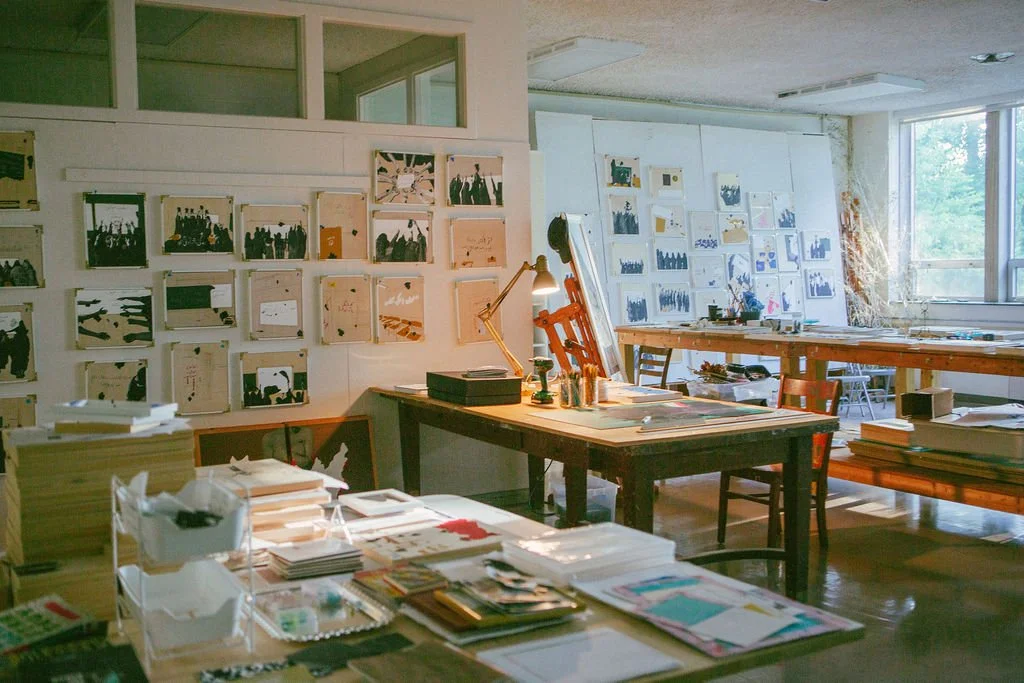
Mojdeh’s studio in June 2025, Image credit: Senna Ahmad
HMB: Say more about your material process, and particularly the stop motion components that make up the projection in your installation. And what are some of the components that evolved over time?
MR: I start out by printing out the image in black and white to the scale of the panels. I cut out the figures from the scene and use carbon copy paper to loosely replicate the environment as a start. Next, I use a pyrography tool to burn the architectural line-work, blackboards, and outlines of furniture from each classroom onto wood. Once I’ve applied the paint and/or colored pencil components, I trace the messages on the blackboards and/or graffiti on the walls of the classroom just as they appear. This part feels like an act of study. The quality of each image is vastly different, so sometimes I can’t tell what I’m looking at and have to really sit with it a long time or leave it blank.
In the case of the stop motion re-enactments, I print anywhere between 15-40 screenshots of one video in order to re-enact the gestures that make it up, and then I cut out each still out of paper and number them on the back (with the help of my cherished studio assistant, Julian) in preparation for filming. Then, I capture the sequence on my phone, using a glass coffee table with a shelf underneath it as my tripod. After completing the backgrounds and filming any improvised stop motion components, I glue down the cutout of the figures using acrylic medium and pour the pigmented beeswax as a last step. Much later in the process, I decided to incorporate one more layer of colored pencil on top of the cutouts for detail on hair and clothing. I also decided to use nail polish – which was prohibited in our schools – in place of acrylic paint to depict the red graffiti on classroom walls.
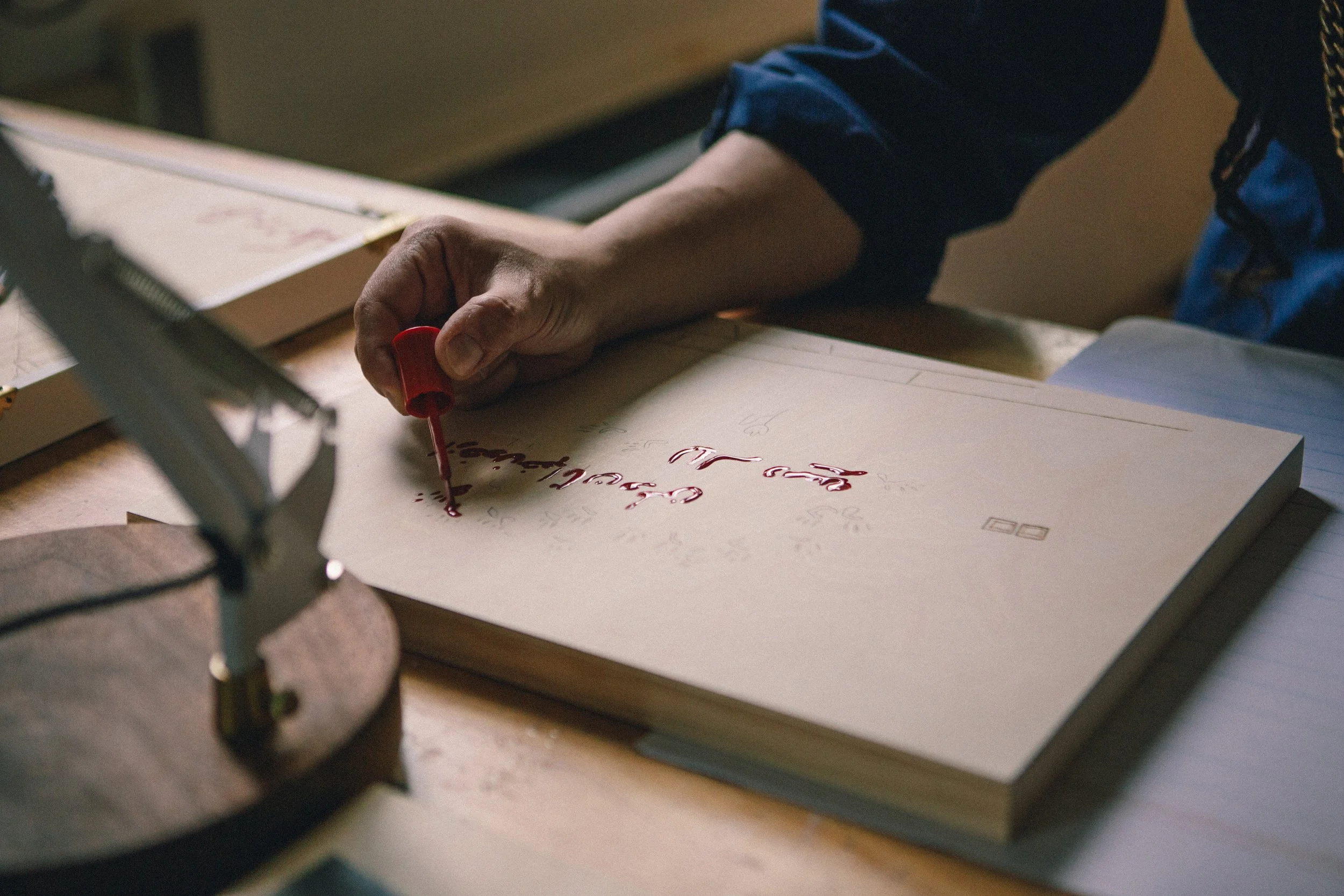
Mojdeh applying nail polish onto the panels in May 2024, Senna Ahmad
HMB: I’m really interested in the interactive element of the exhibition where you invite viewers to pick up a set of questions and write their own answer or response, then offering a mailbox where they can drop their responses. Can you tell me more about how you decided to include this in the work?
MR: A year into working on this archive, my mom — our unofficial family archivist — asked me to retrieve one more box of my belongings from her home. Thinking I had a handle on everything she’d held onto from my lifetime, I was shocked to now find the contents of my immigrant teenage bedroom seemingly frozen in time inside of this box. In the same box there was this drawstring Gap bag with a piece of paper attached to it and there was a note on there that read: “Mojdeh’s middle school notebooks from Iran.” Because we left Iran about 10 days into 7th grade, these notebooks are either entirely empty or barely begun. Flipping through the pages, I was immediately struck by the obvious thematic overlaps with this archive. One page of my English notebook reads: “Good morning. Are you a student? Yes, I am. What about you? I’m a student too.” and there’s a drawing of a blackboard, a ruler, and a pencil illustrating the vocabulary words on another. For a descriptive exercise on the first page of my creative writing notebook, I tell the story of an aging gardener who cares deeply for her flowers. In the end I reveal that she’s a teacher actually and the flowers are her students. There is also my “dictation” notebook with the most number of pages drenched in propaganda, and that’s one that I haven’t even had the capacity to fully read through and decipher.
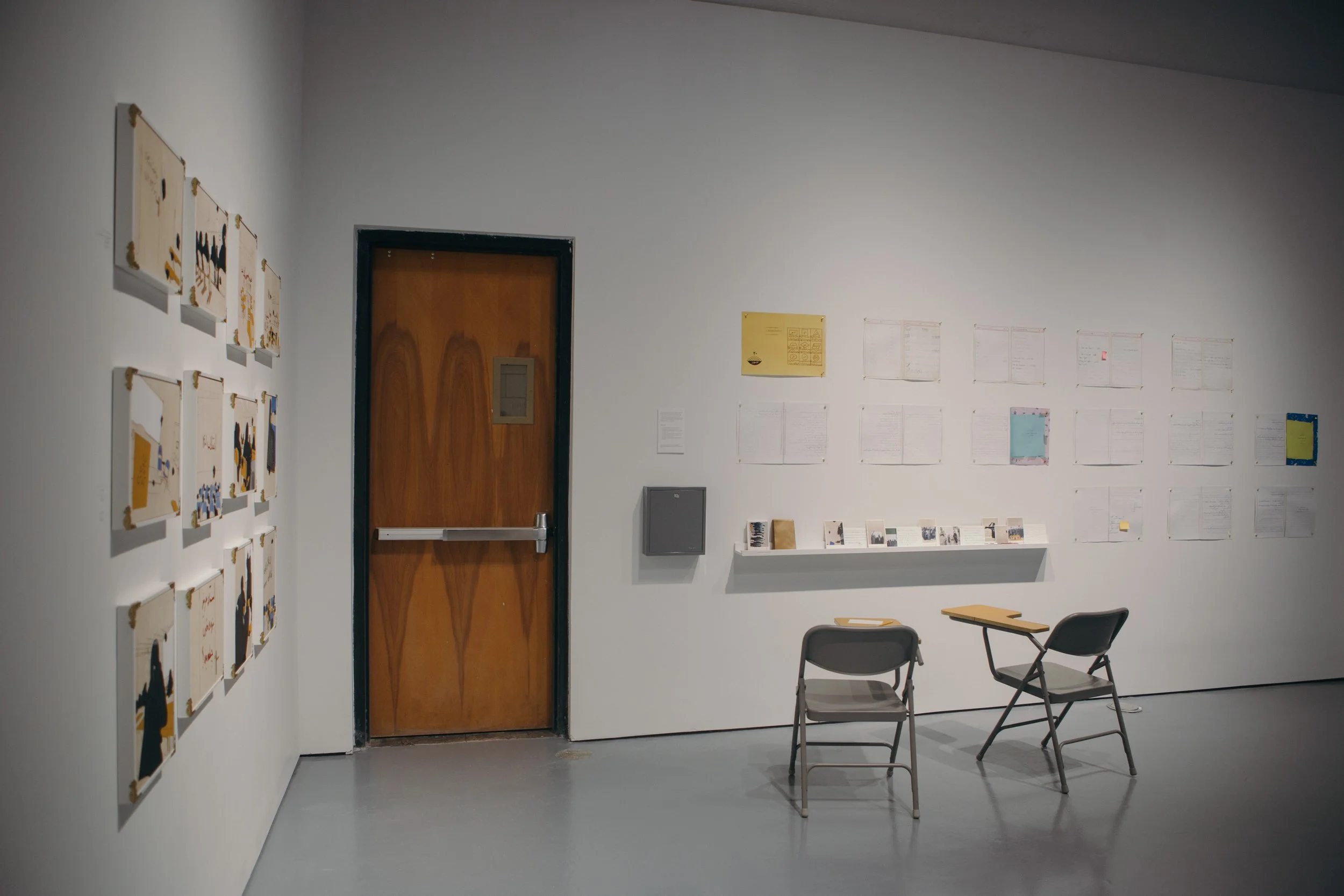
Installation shot from “Classroom Solidarities: Jin Jiyan Azadi” at University of Maryland (2024), Image Credit: Senna Ahmad
MR: Most notably, my science (physics) notebook starts with a series of questions: “What do we know about energy? How do we know when power has been exerted? With great effort, we try to move a big rock forwards or backwards but the rock remains still. Has any power been exerted on the rock? Has any work been done? Explain your answer.” I recognized the physics questions as poetic when I first read them, but it didn’t click how much of a key to everything they would become because I felt so thoroughly exhausted and isolated. One day I decided to invite an intergenerational group of women / femmes / nonbinary Iranian artists to my studio, shared an in depth look at the archive with them, and asked them to tell me what to do. I’d printed these index cards with the images of the panels on the front and notebook lines on the back. I remember handing them out to everyone and saying, “I don’t quite know what the prompts are, but I want you to write on this.” And then I picked up the science notebook and started reading the first page outloud as though moving onto the next topic of conversation. In that moment, everyone looked at me and said, “these are your questions.”
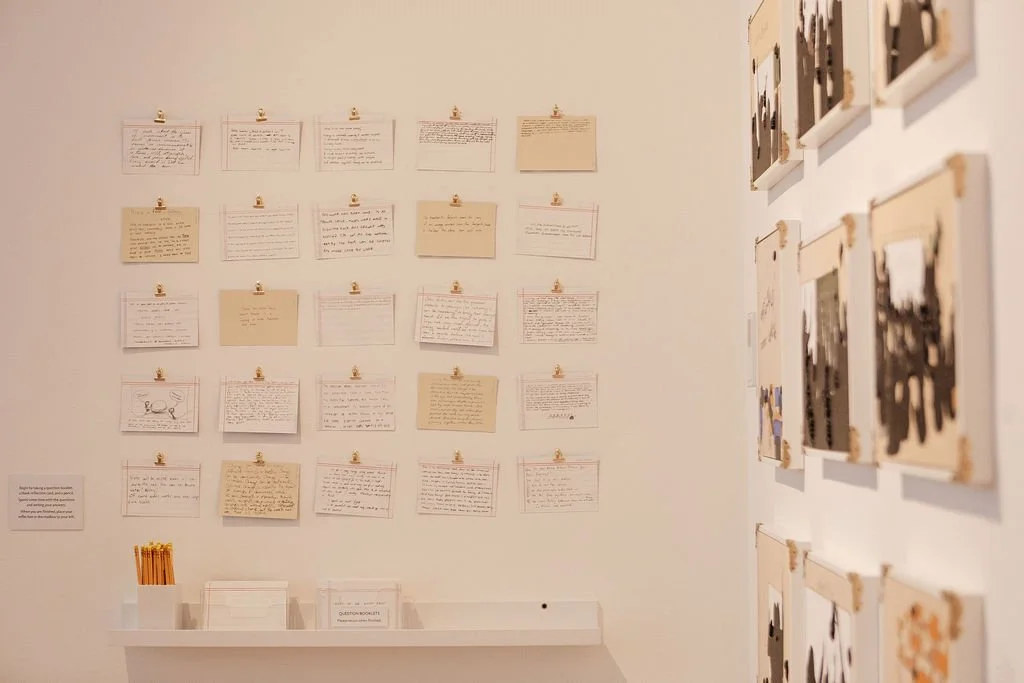
Wall of participant reflections at The Phillips Collection. Image credit: Senna Ahmad
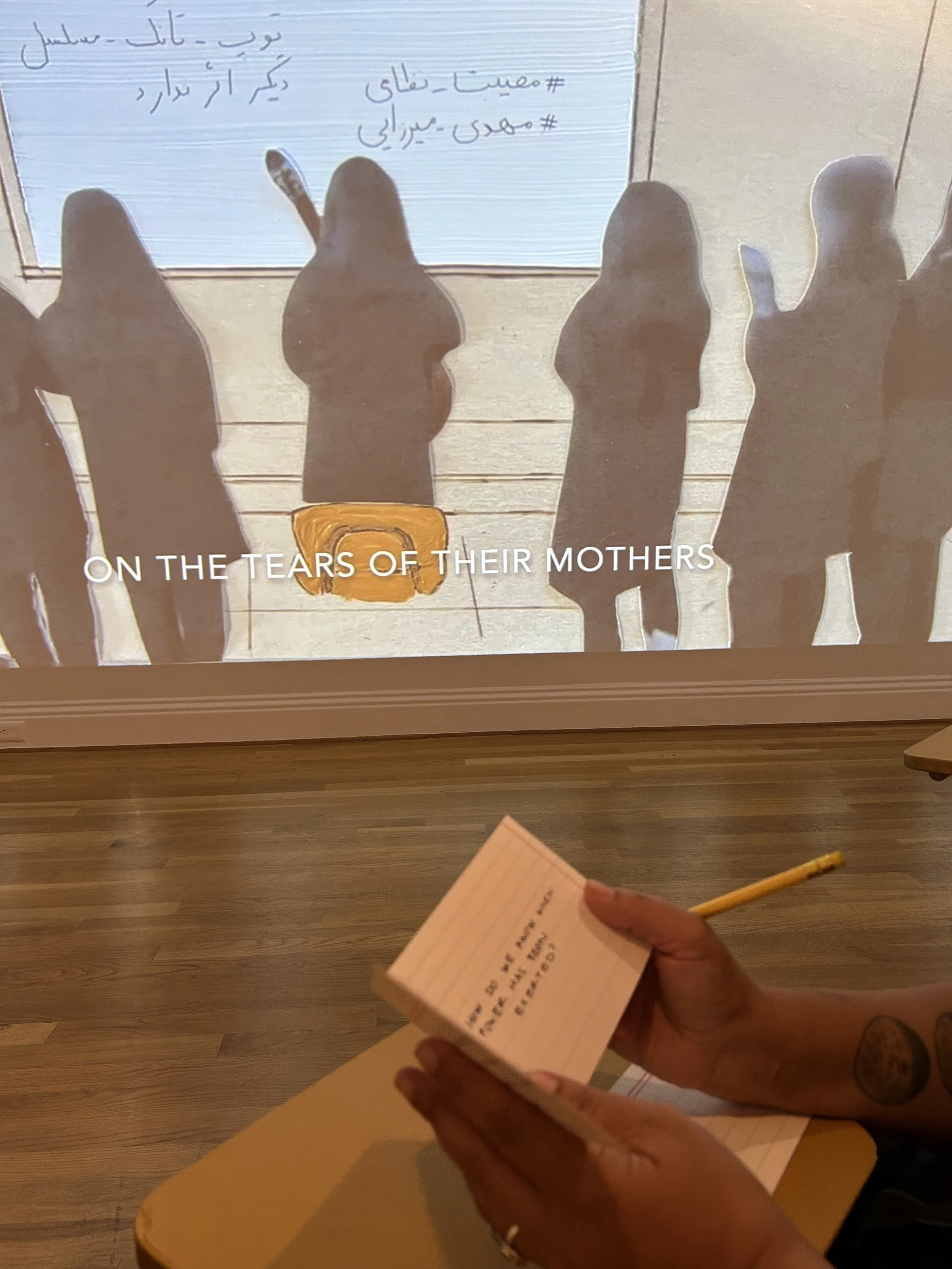
Sitting with the questions in the installation. Image courtesy of Holly.
HMB: How has it been for you reading the responses? Do you have plans for the responses?
MR: So often we put immeasurable energy and resources into a work that seems to come and go in the public eye and then disappear. It’s made a big difference for me, even when I can’t know who all have experienced it, to have a tangible imprint of how the work has moved so many. With the question about the rock especially, an overwhelming majority of people tend to say yes, power was exerted and work was done, and I find that so hopeful. I am also fascinated by how many people say the same thing just a little bit differently and how much wisdom these little bits of difference tend to carry along with them in complimentary ways.
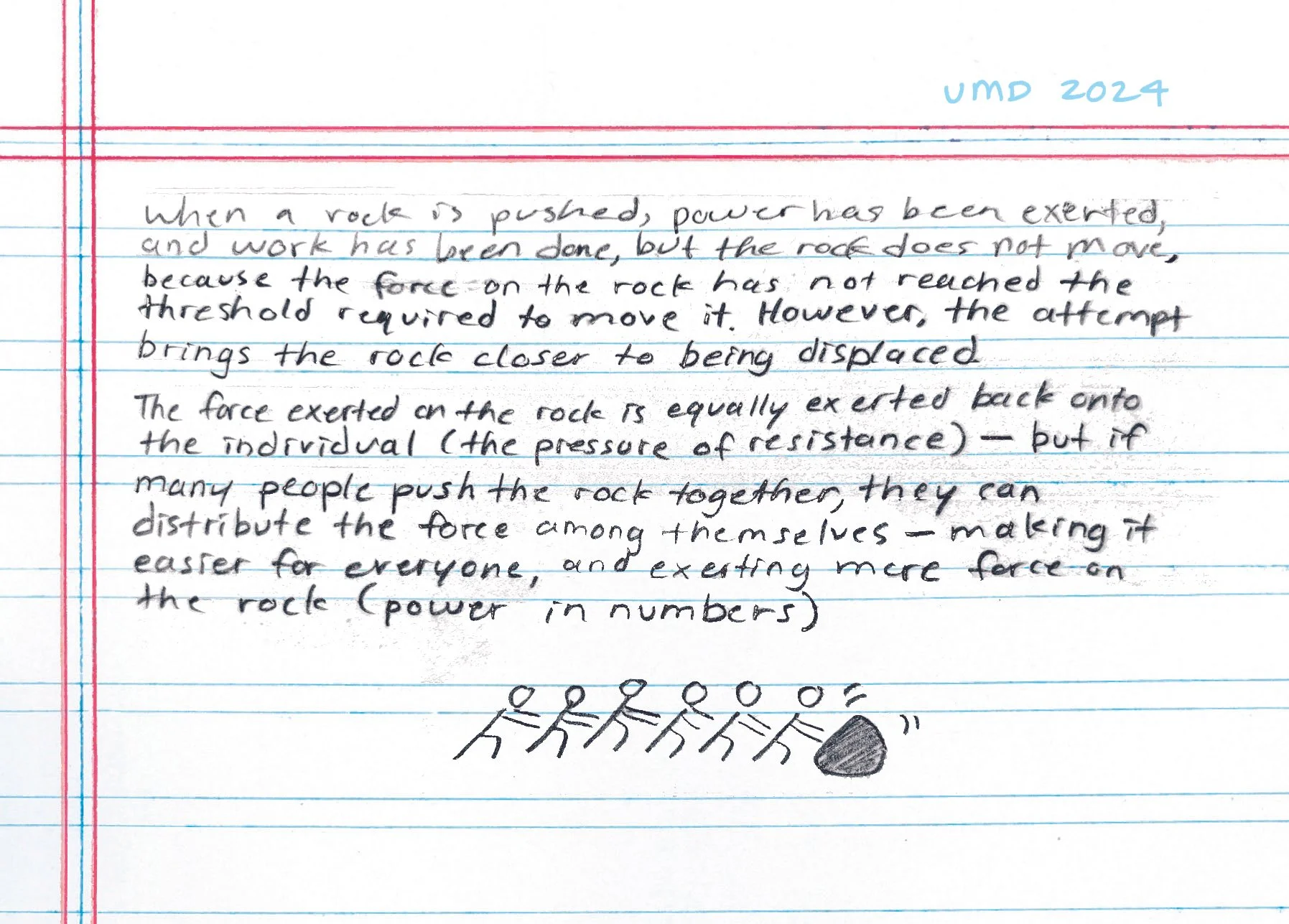
Participant response from the University of Maryland iteration of the project in 2024
MR: The flow of responses at the current iteration of the project at The Phillips Collection in particular has blown me away. Every time I go, the mailbox is full. A month into the span of the show, I already had a stack of about 350 of these responses on my desk which is about as much as I’ve collected across a handful of university activations over two years. I’m amazed that such a large number of folks are visiting and contributing reflections. Alongside university activations, this is where the project feels most alive now, and maybe the beginnings of another work.
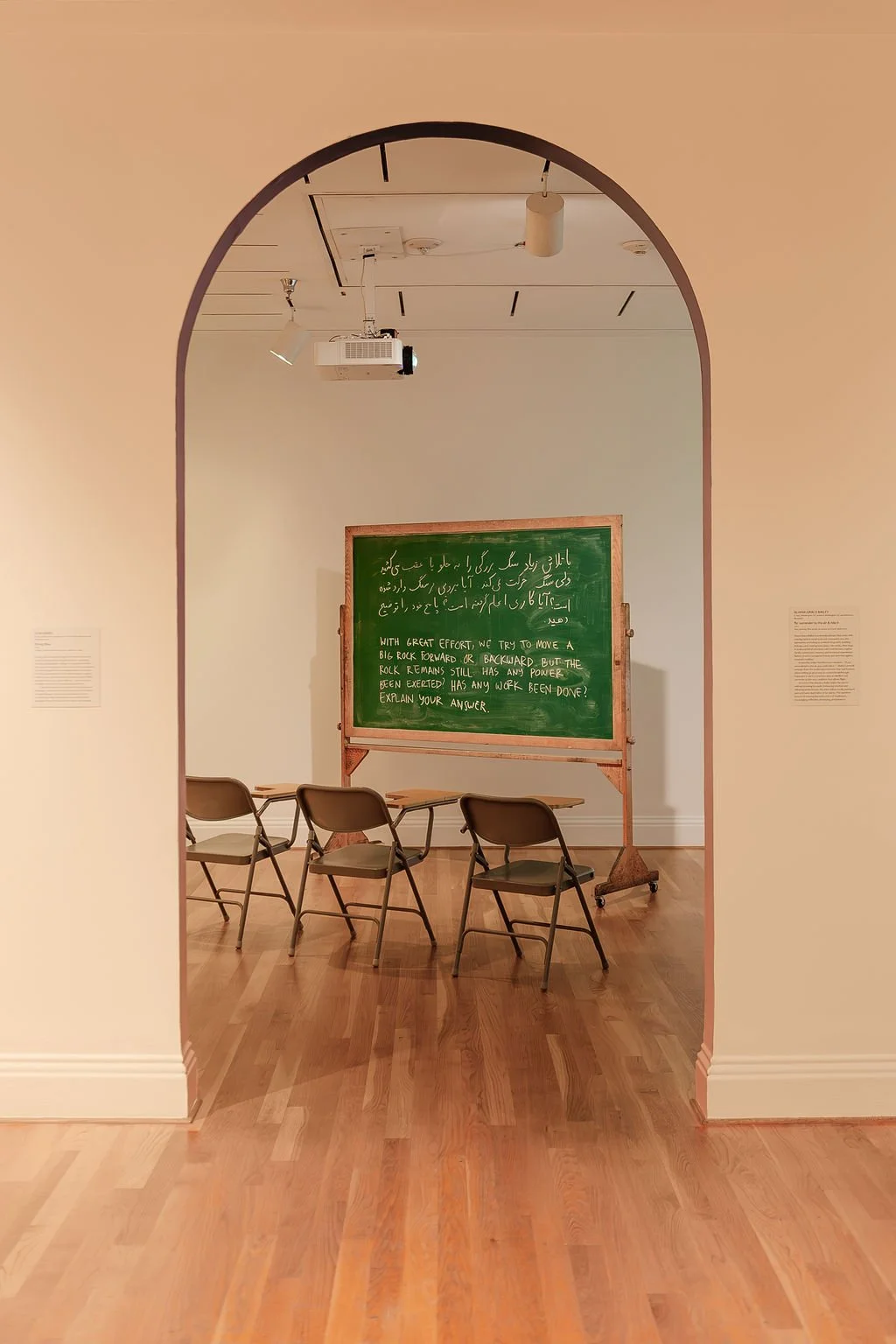
Installation shot from “Classroom Solidarities: Jin Jiyan Azadi” in Tomorrow The Sun Will Rise at The Phillips Collection. Image credit: Senna Ahmad
HMB: Tell me more about the space of a classroom. I know there is a connection related to specific context and the physical location of resistance that you could perhaps elaborate on if you’d like, and what else comes up for you? I keep thinking about the classroom as a space of potential.
MR: I feel like I’ve been nonstop immersed in the classroom by varying definitions for longer than I can remember, so much so that it’s hard to answer this question in words somehow, or maybe I feel like I can go in 20 different directions with it. Entering the classroom definitely marks a milestone in the life of a person I think, and it is such a privilege to have access to that in so many parts of the world, especially for those of us socialized as girls. (The excerpt from Bayan Nasih’s gorgeous short story in Sleeping in the Courtyard popped into my mind just now!) As a container oftentimes held by the state, the classroom tends to be the first place in life where we are expected to conform to certain behavioral expectations, and where many of us learn to perform and/or code-switch under these conditions for survival. We learn to read and write, add and subtract, and so on, but in my case for example there was so much propaganda I was fed too which was quite confusing and disorienting. With the guidance of my family I learned to recognize and filter these out in my home life, and that’s a skill in itself that for a long time I didn’t realize I needed to continue to apply to my schooling once we immigrated here. To sum it up I’d say the classroom is a societal practice ground where we learn and adapt to the shape of the world we are in, but it’s also a place that can encourage us to co-imagine and shape the world as we want it. A teacher can really make or break a learning environment despite the structures that uphold it – I think that writing exercise I did was about my first grade teacher who really cared for us through all of it. Different years at the same school felt like completely separate experiences for me.
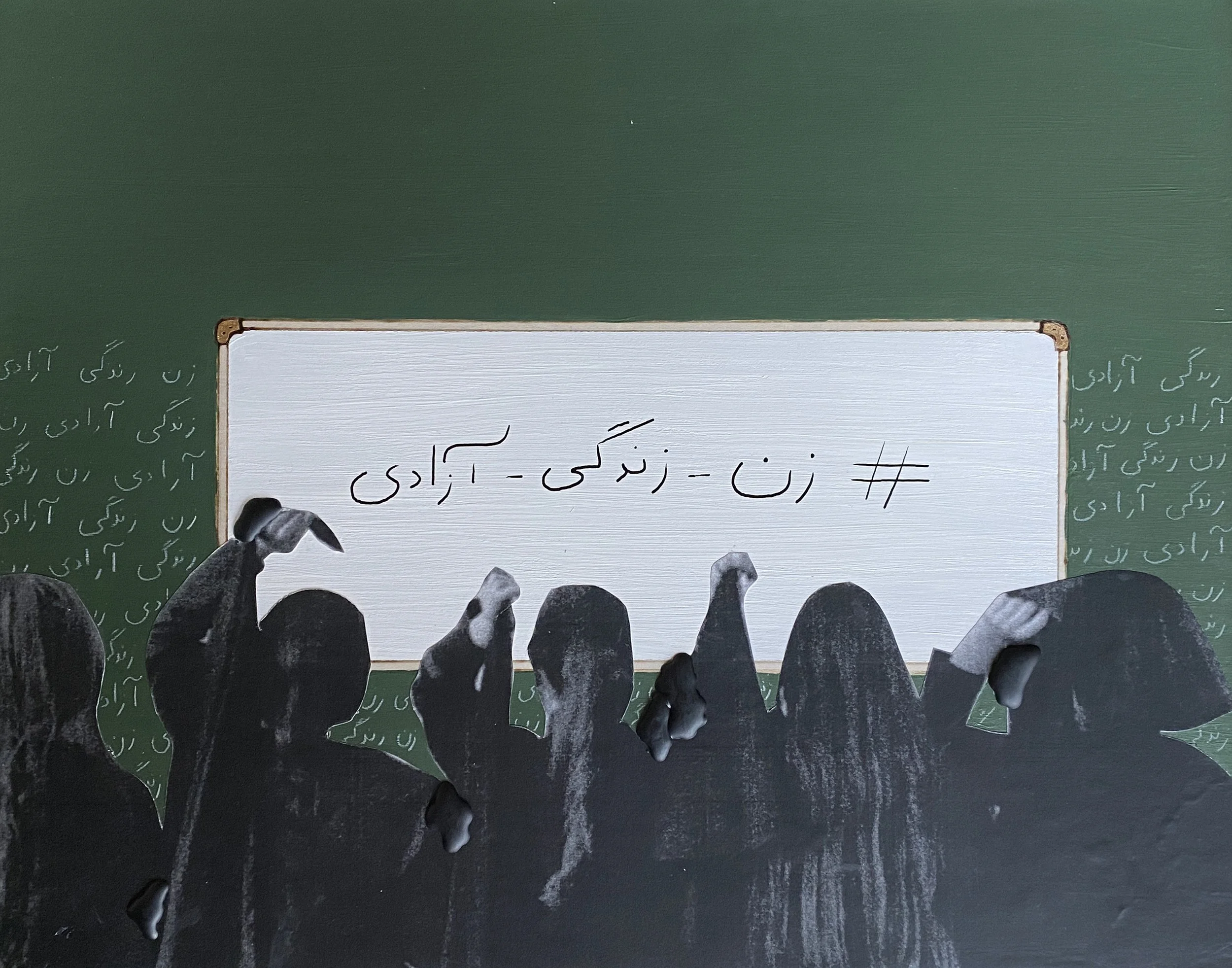
Classroom Solidarities: Jin Jiyan Azadi, panel #2 out of 200. Translation: woman, life, freedom” written many times in Farsi. Image courtesy of artist.
HMB: I noticed in the audio and visual that you invoke concurrent protests and movements beyond Iran and Kurdistan. There’s audio from student-led and feminist movements in the US, Afghanistan, Sudan, and Palestine. Can you talk about the linkage and connectivity you see here that would influence putting these voices together in the same space? In what ways do you see art as an avenue for meaningful intersectional, transnational feminist conversation and engagement?
MR: The illusion of actual freedom in the Western world wore off for me a decade or so after my family and I immigrated here. In educating myself about the history of this country and its layered histories of violence, I finally started to recognize that while the faces of oppression look significantly different on opposite sides of the world, the roots of them are connected and overlapping.
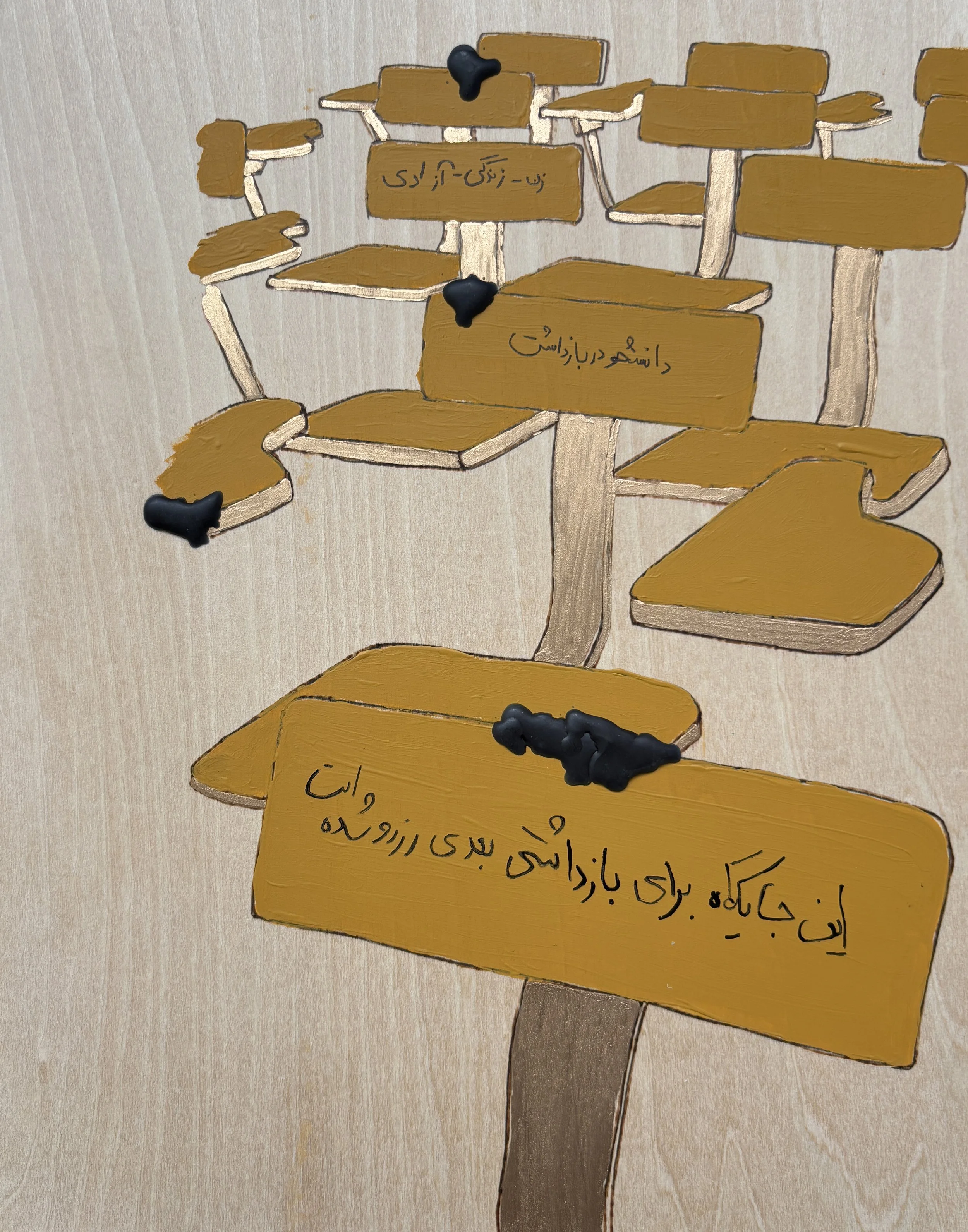
Classroom Solidarities: Jin Jiyan Azadi, panel #178 out of 200. Translations: “woman, life, freedom” “student under arrest” “This seat is reserved for the next student who will be arrested.” Image courtesy of artist.
MR: In spring of 2024, I would often have either Radio Marz (a farsi language podcast that has done a great job archiving individual experiences of people in Iran all throughout this timeline) or Democracy Now playing in the background as I worked. Those days my studio was filled with the voices of American students on university campus encampments for Palestine that were violently being taken down. At the same time, the panels from Iran I was working on specifically were mostly empty classrooms from about three weeks into the movement in 2022, with messages addressing the increasingly deadly repression: “Stop the repression of students on campus” “This seat is reserved for the next student who will be arrested” “The danger of normalizing atrocity.” The overlaps in the messaging in this source material and in the voices from concurrent protests in the US were uncanny and I knew what I needed to do.
For years now, much of the source imagery I’ve used in this project has been carefully co-opted to manufacture consent for the war that has now been waged using our tax dollars on these same revolutionaries’ homes and schools under the guise of liberation. The incorporation of sound components from these various contexts allows people to draw their own connections between the atrocities and solidarities alike, and in doing so refuses a harmful flattening of narrative.
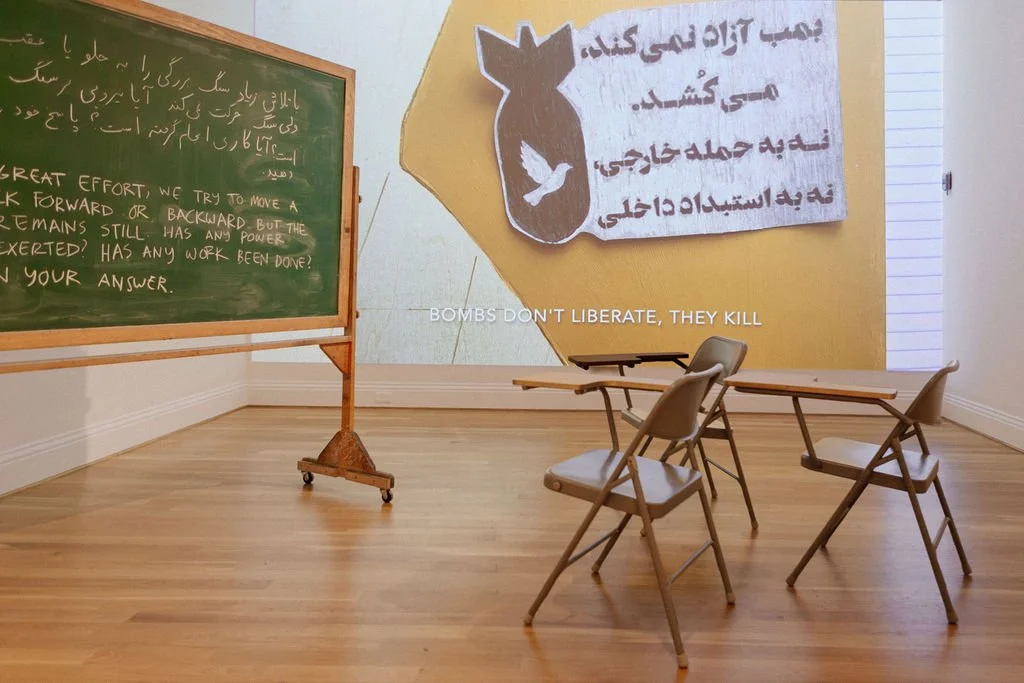
Installation shot from “Classroom Solidarities: Jin Jiyan Azadi” in Tomorrow The Sun Will Rise at The Phillips Collection. Image credit: Senna Ahmad.
HMB: We live in an age of social media inundation. I’d like to hear your thoughts about the way art circulates through these digital spaces and your decision as a visual artist to abstain from these platforms in large part.
MR: After recognizing the platforms as the time, energy, and data vampires that they’re fully designed to be, I have been experimenting with boundaried engagement with social media over the past seven or eight years. My initial clarity was around not taking “breaks” from social media (because that was never successful in my experience), but to use it as a tool in short spurts. The latest iteration of these experiments looked like a complete deactivation of my accounts for at least eight months each year, and coming back during my most publicly active season to join the efforts of my collaborators and/or hosting institutions to share ongoing projects more widely. The last time my account was active was February 2025, at which point I decided to screenshot everything I wanted to archive and currently have no plans to reactivate my account. I did make a project page for Classroom Solidarities recently (@classroomsolidarities) that just posts documentations of the project and process with date and place with no like counts, no comments, no statements, and no artworks. It’s really just there so that if someone wants to discover the project beyond the website or share about it to their community, they can.
I try to reject the momentum growth model as an ethic and move at my own pace. I’ve prioritized direct engagement with the work one on one through various subsets of dialogue partners, via lectures and workshops on university campuses and in community contexts beyond that. Opportunities do pop up via email or contact form on my website, but mostly I build with folks intuitively and through a rigorous outreach approach. As the archive has grown, it’s really found its shape in community. I went to a talk at The Hirshhorn last week where Joan Jonas, at 90 years old, was talking about her audience being the other artists she was in community with for a long time, and I really relate to that. I probably would have stopped doing this long ago if it weren’t for the support and witnessing I am surrounded by.
HMB: Do you have a favorite piece (or pieces) from the other artists in Tomorrow The Sun Will Rise at the Phillips Collection? Or one or some that speak to you in particular?
MR: Madyha Leghari’s intricate etchings on slabs of pink salt really moved me as I entered the space for the first time. Leslie Holt’s embroidery of notes and lists from her mother, a theoretical physicist, during her last psychiatric hospitalization. Gail Shaw Clemon’s colorful paper sculptures honoring her mother’s longtime work as a clerk typist at the IRS. Ringo Lisko’s site specific work made of dust swept up at the museum. Aishwariya Chandrasekar’s intricate embroidery of waves on a small cotton cloth. Kei Ito’s “Sungazing Scroll,” especially after I heard him talk about the work on a panel we were both on in August. Both of Hannah Attallah’s works on view, but especially “Namesakes (Portrait of Najli Al Ali)” which feels like an archive unto itself. I could keep going.
Mojdeh Rezaeipour (they/she) is an Iranian-born transdisciplinary artist and storyteller. Incorporating analog collage methodologies across various mediums, Rezaeipour’s practice activates personal and collective archives through iterative long-term projects, collaborative research, and pedagogical engagement. Their solo and collaborative projects have been exhibited nationally and internationally in a wide range of venues, from DIY project spaces to larger institutions and platforms. Her words and voice have been featured on many outlets including Image Journal, The Washington Post, and The Moth Radio Hour, among others. In 2023, she was featured by Cultured Magazine as one of “7 Artists Making Waves” in Frieze LA’s Focus Section. Rezaeipour continues to share and workshop ongoing projects on various university campuses including UMD, GWU, VCU, UCLA , UCSF, and Northwestern. An immersive Classroom Solidarities installation is currently on view as part of Tomorrow The Sun Will Rise at The Phillips Collection until September 20th.y teaches in the creative writing MFA program at UMass Boston.