haven steel
nonfiction 2026
guardrail
Two Novembers ago, I realized the girl I loved didn’t love me back. This November, it was my sister. We argued; I hoped. She reminded me that we had been through the worst times of our lives together; I begged her to continue the trend. She promised me that I would be the maid of honor at her wedding. I asked her why she voted for a man who would prefer that mine never happens. She was silent.
I have a compulsive need to make everything about myself. It’s what I do best—as the daughter of a narcissist, as a mother who is not a mother, except for in the ways that my mother lives inside of me. When I was younger, I kept diaries. In nearly every entry, I would end with my life-long mantra, a prayer back when I still believed in their power: I won’t end up like her. Once when I was 14, I woke in the middle of the night to see her perched on the edge of my bed, flipping through my secret pages in the dark. I asked what she was doing. “You’re dreaming,” she told me. “Go back to sleep.”
I told my sister I was afraid she would die in pursuit of motherhood. She told me she was afraid I would die without knowing the Lord. We have reached an impasse.
*
Every time I consider giving up on my mother, I think of her banana bread. She makes it with rotten fruit, yellow gone black. She says it’s better that way. I don’t even like bananas, not really. But often when I’m drunk, I walk to the nearest gas station and buy a bushel, eating at least three in one sitting. I pick the freshest ones I can find, yellow-tinged green. They never taste right, but I force myself to eat them all. It makes me almost sicker than the alcohol. It started as a funny anecdote at my friend’s first house party. Now, it’s something of a tradition, or maybe a compulsion. People like to tease me about it, from time to time. They ask me why I pretend to hate bananas so much, when I obviously, deep down, have some sort of craving.
*
At night, my mother would dance around the kitchen to Fleetwood Mac, waving her arms and closing her eyes, head tilted back in some manner of spiritual ecstasy. In the mornings, she’d drive us to school, knuckles white on the steering wheel, and accuse my sister and me of wanting her dead. “You’d be happier that way, wouldn’t you?” she’d cry, her voice trembling, the car rocking. “I could do it right now.”
There was a bridge we crossed to get to my school in the years when my sister and I were separated only by age and grade. It stretched across a river. I used to grip the handle and pray for deliverance. My sister told me that she almost did it, one of those times. After I’d been dropped off at the land of middle-schoolers, during the crossing back over into my sister’s world. My sister trapped in the car, too small to ride in the front seat, too impulsive to hold her tongue without me to hold her back. The way she tells it, they veered so close to the bridge’s edge that she could see men casting their fishing rods on the shore below. The way she tells it, our mother’s scream was like a record scratch.
*
We used to swap stories like these on holidays, both of us back in town against our will. Out of some lingering protective instinct, I always offered to drive. I am a very calm driver. It took me three years to lay my hand on the horn. I would deliver us to my mother’s house, where we would endure something absurdly horrible together, and then back to my father’s house, where the absence of sound was somehow worse. On the road between, in the dark, lingering silence, we would talk. Really talk. Do you remember, prompting more and more and more. We liked to laugh about how much we’d forgotten, at how unreal memories seem when they resurface. Do you remember when we ran from the cops, she said once, across from the elementary school, and everyone was staring from the parking lot? We laughed until we were in tears, and then we crossed from the car to my father’s house and let the quiet swallow us whole.
I did want my mother dead. It’s true. That’s the funny thing about paranoid people—sometimes, they’re right. I imagined that after she died, my life would finally start: some sort of cosmic transference. I imagined that after she died, I wouldn’t be afraid or sad anymore, because those words defined the girl who was my mother’s daughter, not the girl who would belong only to herself. Somehow, we are both still alive. I once thought this was a paradox.
*
I might never get married. I might never be a mother, because I have already been one, walking to the dollar store with a bag of nickels to buy baby formula for my little brother. Walking my sister across the field at senior night so she wouldn’t walk alone. Walking to my mother’s locked bedroom door, pleading with her to come out and take care of them. Later, when she was locked behind the bars of a jail cell, I wrote down a prayer that I knew she couldn’t steal away. I don’t want to wait until she’s dead to be happy. Though she couldn’t have read it, I was still terrified that she knew.
*
The girl I loved told me I was addicted to tragedy. She might be right. I don’t love people the way other people love; I don’t love selflessly enough to marry or mother. I love in an inherited way, needy and paranoid and insecure. I love with a tight grip on the handle, imagining that no one will want a girl who aged backwards, a girl too afraid to make noise. I love like bananas; the freshness makes me sick. I need something rotten, something familiar. I asked my sister if she loved me, and she said she loved the Lord. I thought: Finally.
*
I am in the car with my mother, and I could do it. I could take us both over the edge, if that’s what makes her happy—but I don’t think it does. I think she was happiest dancing in that kitchen, arms spread wide. I think she was happiest waiting for the bananas to turn black. I think she was happiest as a little girl, climbing mango trees in Jamaica, watching from the highest branch as her father came home from work, whistling. The way she tells it, before the cancer took him, he made such beautiful music. He was the lowest bass in the church choir. She’d scramble down the tree, and he’d lift her up onto his hip, laughing. There’s my girl, he says, and we are all there on his hip: my mother and my sister and a younger version of me, the type of young I never was. My mother turns to me with a smile, light and carefree. “You’re dreaming,” she tells me. “Go back to sleep.”
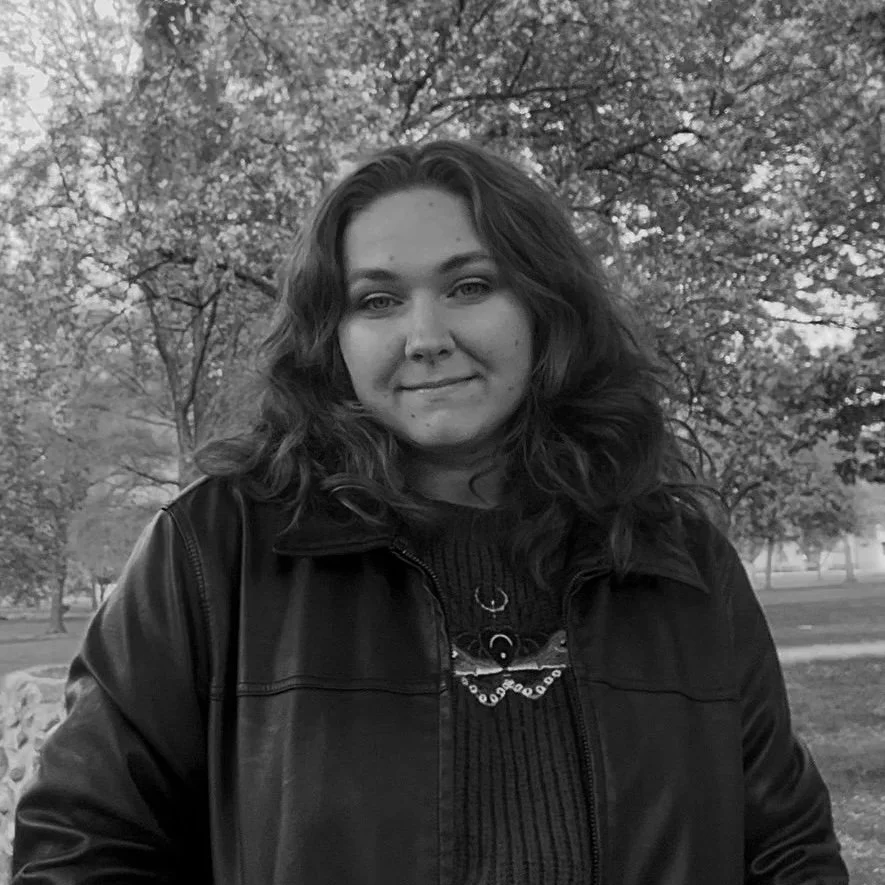
haven steel
is a queer multi-genre writer from Central Florida. She currently studies and teaches at Minnesota State University, Mankato, where she was selected for the Robert C. Wright Minnesota Writer's Award in 2025. Her work is published in Arkana Issue 19 and received the Editor's Choice Award. You can find her online at www.havensteelwrites.com