Stitching Memory and Heritage in Patchwork: An Interview with Maddie Ballard
Maddie Ballard's debut book, Patchwork: A Sewist’s Diary, is an inventive memoir in essays about family, heritage, self-discovery, and much more. Patchwork was published by Tin House on October 21st, 2025. The collection explores the making of 17 garments over a period of great change in her life, such as a jacket lined with the names of Maddie’s female ancestors.
She has agreed to speak with So to Speak staff on the influence of feminism and culture in her work, as well as the book’s structure and the process of sewing as both metaphor and practice.

Grab your copy of Patchwork by Maddie Ballard here.
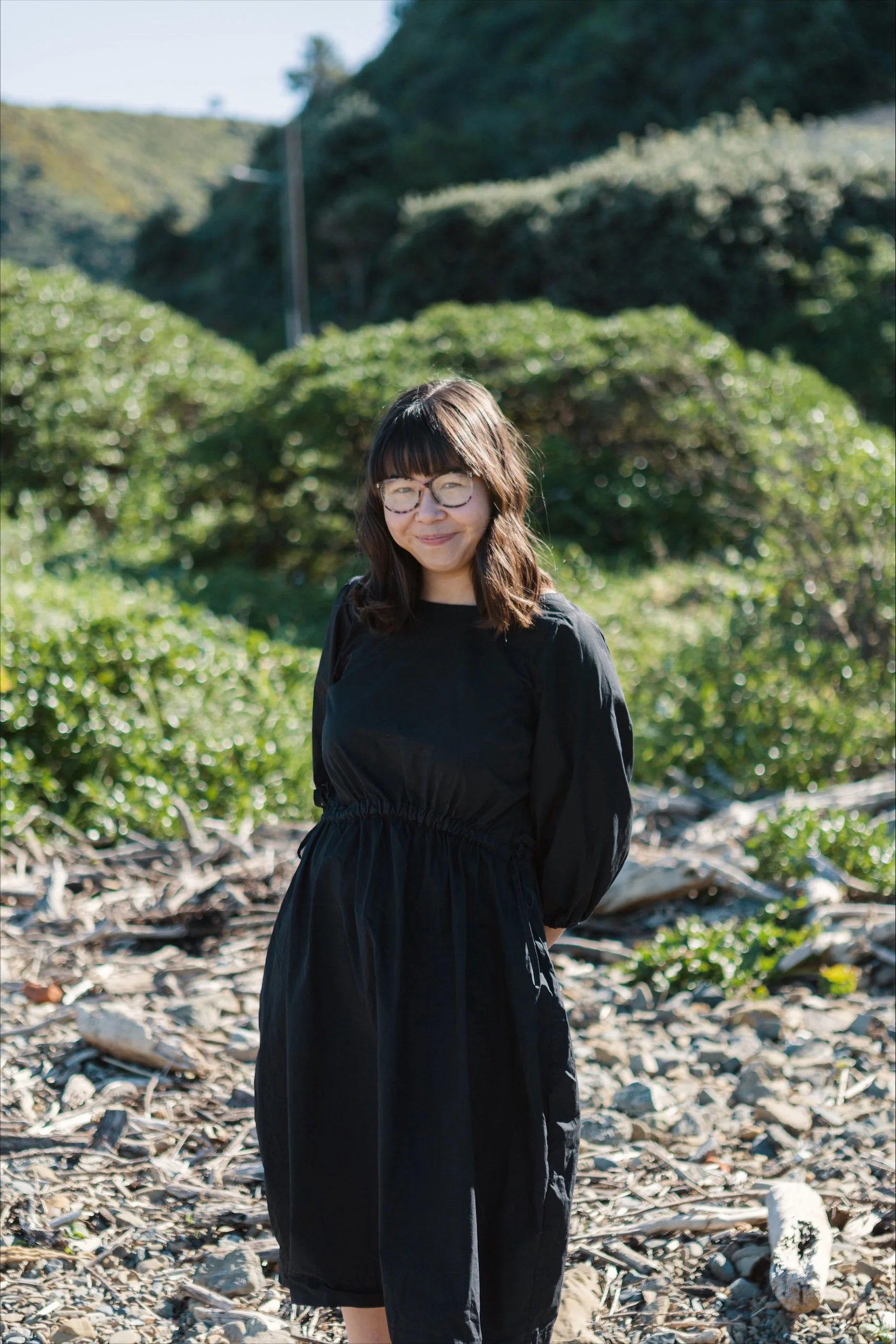
Photograph provided by the author.
Matti Ben-Lev: I wanted to start with something specific, from the opening of the book. On the first page, you write, “Again and again I fumble with needle and thread. This is a love story.” Can you talk about why you chose to set readers up to call this a love story, as it both is and isn’t? Both in terms of your personal intimacy and the larger sense of cultural inheritance, the act of care that accompanies the step-by-step sewing that runs through the book.
Maddie Ballard: I wrote that introduction last. It took me a long time to arrive at the framing. I was hesitant to put that in at first because I wondered if it might be read as being a book about a breakup, which in some ways it is! But really the love story is about falling in love with a new skill. And I guess also about how being patient with yourself while you learn a new skill is a form of self-love.
In terms of wider self-acceptance, sewing is a way of getting to know your body, your aesthetic taste, and figuring out how to defend those things without shame. That’s something I’ve struggled with, and I know lots of women and people of color struggle with.
On the cultural side, I’ve always felt unsure how to relate to that part of my heritage. My mum is a Chinese New Zealander, and my dad is a Caucasian guy from Texas. All my mum’s family lives in New Zealand, and they’re all Chinese, so they’re the family I grew up with. But there’s a slight disconnect, because I also feel I don’t quite fit into that group in some way.
Writing into that Chinese side through sewing was a way of making it feel more comfortable, of honoring that part of me.
MBL: I love the way you dug into both the metaphorical and physical act of sewing to explore heritage and self-understanding. “Second Skin” was my favorite essay in this collection because it feels like there’s this sort of emotional tension boiling over.
You write, “I sew seam after seam, seething and methodical.” Then, you go on to sew the Cantonese names of your female ancestors into the seams of the Paola Workwear jacket you’re creating. I really get the sense that you’re using sewing not just as an outlet or a way to fill time during the pandemic, but also to connect with cultural heritage. Can you speak to how making that jacket allowed you to bridge personal experience with cultural heritage and feminism in relation to ancestry?
MB: That essay feels like the pivotal essay of the whole book to me. A corduroy jacket is a Western garment, and I have no personal connection to corduroy. But I liked the Paola’s design and that a jacket can have a lining, this secret other side. It let me put the names of my ancestors inside as a way of exploring heritage without making it public. Later in the book, when I make a cheongsam, everyone can see what I am doing. You have to be brave to wear something like that. You might face questions. If you’re wearing a black jacket, no one assumes anything’s on the inside, but you know it’s there. It felt like a safer way of exploring that at first.
I think it’s fair to say that Chinese culture is traditionally very patriarchal. There’s a lot of emphasis on the sons of the house. But my experience of Chinese culture in my family has been very female. There’s my mum, of course, but I’m also close to my grandmother, and I knew my two great-grandmothers before they died. From a feminist perspective, it’s important that those lives are held up as precious, even though my female ancestors weren’t highly educated, and a lot of their work was domestic. I don’t know if they lived particularly happy or fulfilling lives, but the work they did and the service they gave are important to my family. I wanted to honor that. I decided to include only my family’s female names because that felt like a true representation of what it meant to me to be Chinese.
MBL: I want to pivot and discuss the book’s structure. The content is about making and remaking—clothes, memory, identity. You mimic that by stitching together essays like pieces of a garment. Can you talk about shaping that? When did that connection come together?
MB: It came quite early. When I wrote the book proposal, I had to give a chapter outline. I wasn’t thinking so much about the identity side or the story under the story, but of the different parts of the sewing world I wanted to represent. It’s a microcosm that touches many larger political issues. Sewing touches the environment, body positivity, identity, the internet. I wanted all of these areas represented somehow across the collection. And then as I worked on it, I discovered I really wanted to write about my family and relationships, and the way relationships change.
MBL: One thing I found interesting was when you reference a political component to sewing. You point out how garment and textile workers, mostly in the Global South, mostly women, often work 10-16-hour days in terrible working conditions for poverty-level wages. Do you see your personal sewing intersecting with global feminist labor struggles?
MB: I feel complicated about it, because the sewing I do is nothing like what most garment workers do. For me, it’s a leisure pursuit. I’m very aware of the privilege that involves. One thing I appreciate about sewing is that it makes me think about how much labor goes into making clothes—and into all sorts of other things I take for granted. There’s labor in growing the food I eat, or running the city I live in. Other people’s largely invisible labor makes my whole life as a middle-class person in a Western country possible. I think it’s incredibly important to reflect on that, even if there’s little you can do as an individual to change the system. When I do buy a piece of clothing, I appreciate that it was made, by skilled human hands, in a way I didn’t previously.
MBL: That connects so clearly to the beginning of the book— “This is a love story.” In the essay “Soft,” moths start eating your clothes, and you describe a methodical way of getting rid of them, mirroring the methodical process of sewing. It’s also an essay where you use section breaks, which you didn’t do elsewhere. How did you choose to structure this essay specifically, and how do you see the form reflecting the tension between control and chaos?
MB: It was a practical decision. I knew I needed to get from the essays before that, set in a period of being in a settled relationship and lockdown, to the unsettled essays afterwards. I needed to indicate that things had broken down. And I wanted to do it in a way that didn’t tear down my ex-partner. There’s always a risk in nonfiction because your life touches other people’s lives. I still care deeply about that ex and didn’t want to tell the story in a way that would hurt him or suggest I was writing down any kind of objective truth. I can only tell my side of the story! A fragmented structure gave me a way around providing every detail. I loved writing that essay because it was a bit different from all the others, and I think moths are really cool! But initially, it was a practical way to handle a delicate personal situation.
MBL: I love how you use form to indicate the change, and in the next essay, we can see the shift. This connects to you sewing the names of your female ancestors on the inside of the jacket; you play a lot with what’s said and not said, what’s visible and not visible. Can you speak more to the white space between what you say and don’t say?
MB: Something my writing teacher used to say is that good nonfiction should convince the reader that its quarry is bigger than its ostensible subject. Your reader might think they’re reading a book about sewing, but by the end they feel it’s about something deeper. I love that gesture of opening to or suggesting more than is on the page and I think a lot of that comes from selecting the details you leave out.
MBL: Since you brought up “Silver Lining” earlier, there’s a quote I pulled: “The day I finish the coat, I’ve been living with 婆婆 [Por Por; grandma] for a month… She still hasn’t realised I can understand almost everything she says in Cantonese. I hear her telling everyone she knows that for some reason I am making a coat, and that she’d like me to stay.”
Those lines feel profoundly emotional to me. They beautifully combine longing and cultural distance. Sewing this coat feels like a way of situating yourself inside your grandmother’s lineage. How did sewing become a bridge between generations and languages?
MB: My grandma was a sewist. When I was growing up, she did lots of sewing, mostly alterations. I remember being fascinated by her sitting at the machine. I’ve always associated sewing with her, and I’ve inherited her machine now, so that’s a direct link.
Metaphorically, I think the act of making itself links me to her. My por por is a very creative person: a great cook and gardener as well as sewist. The act of making with one’s hands really makes me feel close to her, particularly because we can’t always communicate very well in words. She’s the last living member of my immediate family whose primary language isn’t English, and my Cantonese is pretty wobbly. Sharing an enjoyment of making things is one way we can feel connected.
MBL: Last question: what’s next?
MB: I’m currently editing a full-length essay collection that’s more miscellaneous than Patchwork. It’s about doubt in various forms—all sorts of big knotty things I feel unsure about. Sorry that sounds so woolly in abstract—although maybe that’s fitting! We’ll see if I can get it together.
Maddie Ballard is a writer and editor of mixed Chinese heritage. Born in Syracuse, New York, she grew up in Aotearoa New Zealand and currently lives in Melbourne, Australia. Patchwork is published by Tin House and available for purchase here.
Matti Ben-Lev is a queer nonfiction writer and poet based in Northern Virginia. His writing has appeared (or is forthcoming) in McSweeney's, Rumpus, CRAFT, X-R-A-Y, Ekphrastic Review, Jake, and elsewhere. His unpublished chapbook manuscript, "letters to jimi hendrix," was a semi-finalist in FLP's 2025 chapbook contest. His work has been supported by a summer residency with The Inner Loop in DC. Find him at mattibenbenlev.com/