
The Question of Home: an interview with Shubha Sunder, author of Optional Practical Training
Shubha Sunder’s novel, Optional Practical Training, is a series of conversations between the protagonist, an immigrant named Pavitra, and a wide variety of characters she meets over the course of her year under Optional Practical Training status, an extension of the U.S.A. student visa for work experience. Optional Practical Training was published by Graywolf Press on March 1st, 2025, and recently won the 2025 New American Voices award.
Shubha spoke with So to Speak staff about the novel, including the unique perspective of the immigrant by choice, the role of observation in immigrant experiences, and the concept of home.
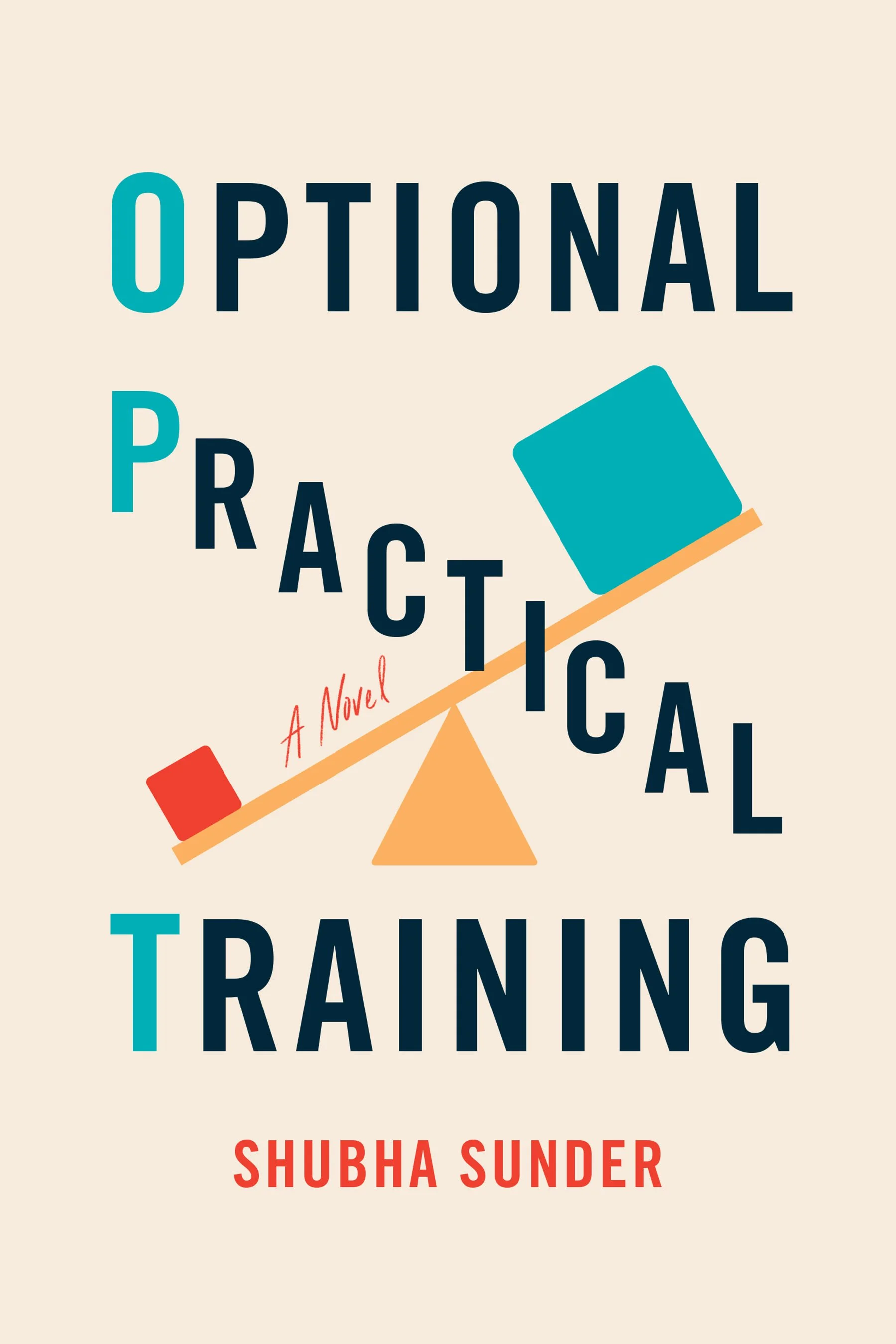
Grab your copy of Optional Practical Training here.
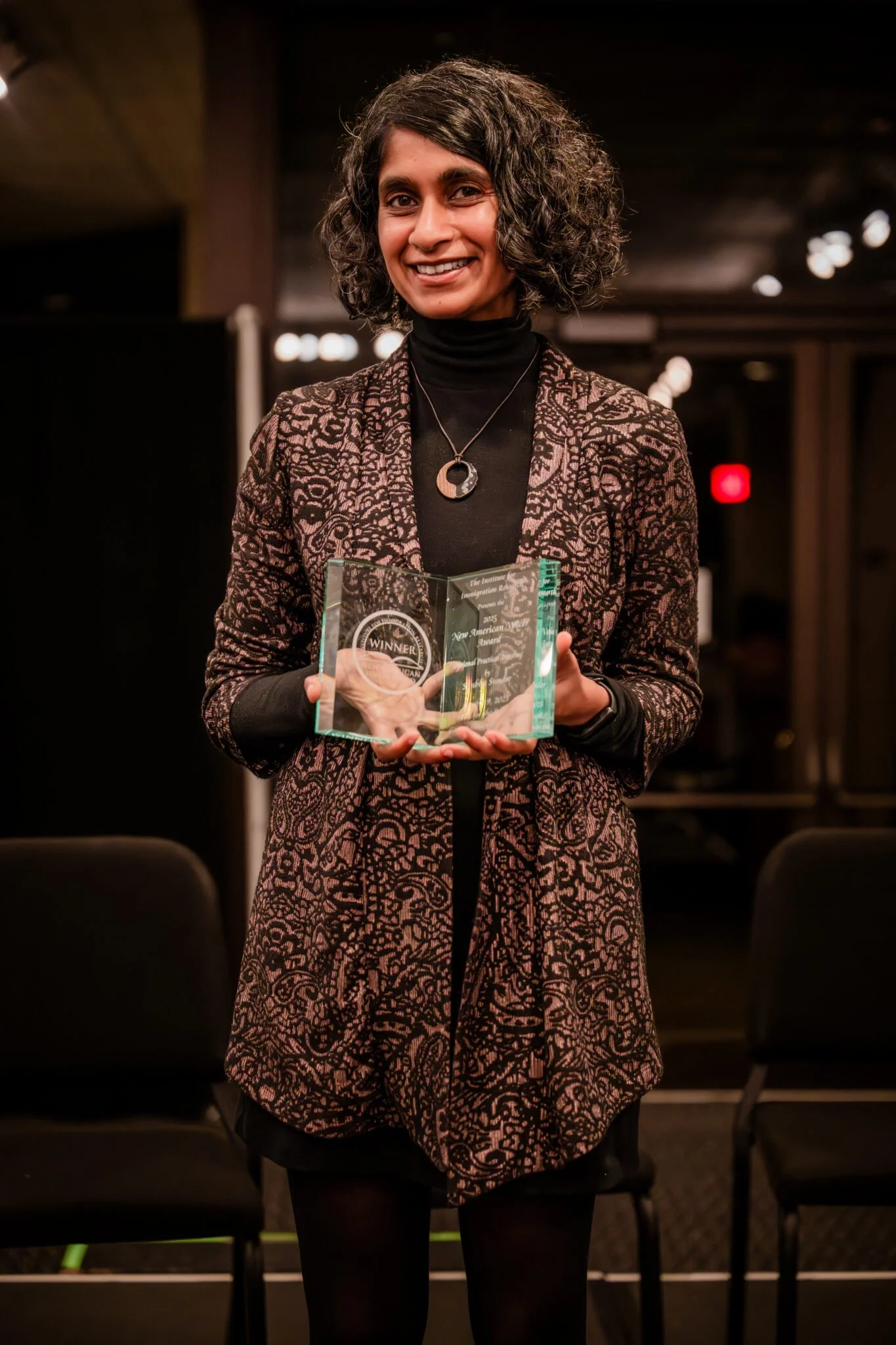
Photograph from the 2025 New American Voices award.
Erin Hoskins: I so enjoyed Optional Practical Training, I read it two weeks ago and I’m still thinking about it. I wished there was more to read when I was done! I wanted to know what happened next.
Shubha Sunder: Thank you for reading it! It’s actually the first of a trilogy of immigrant novels. I’m working on the second and hope to have it done next year, fingers crossed.
EH: Amazing! Is it following the same protagonist?
SS: Yes! Same character, but a different stage of life. It will be called Conditional Permanent Residency. Like Optional Practical Training, the title refers to one of those bureaucratic names for immigration statuses.
EH: I’m so excited to hear that! My first question is about the structure of the book and how much of it is conversations that Pavitra has with other people. How did you decide to orient the book on those conversations?
SS: I didn’t know in advance that this would be the structure of the book. When I was starting out, I wrote a few rough pages that ultimately became the first chapter, where Pavitra is looking for an apartment talking with her prospective landlord. I observed after the first draft that she doesn’t say much directly. It’s the landlord who talks, and I found myself thinking that it was interesting. It’s a new way of looking at the immigrant experience. When you are a foreigner in a country, any interaction you have with someone is not just a conversation between two individuals. They each represent their respective worlds. She, as a foreigner, is not going to see the landlord as just any person but as a representative of America in some way. And similarly, for him, the fact that she is a young woman from India means she represents more than just herself. She’s very young, twenty-two and straight out of college. The conversations don’t just paint a portrait of this slice of the United States she’s parachuted into, the things people say to her inform who she is in this particular world. A young woman like her absorbs conversations, and they help to build her identity as an immigrant in the US. When I saw how this conversation with the landlord unfolded, I decided to extrapolate that rule to every person she meets.
EH: On the note of the landlord, I found him to be an interesting throughline. He starts the book, and comes up a few more times, and then at the end, when Pavitra decides not to renew her lease with him, it felt like it represented a transition for her. What inspired this character and throughline?
SS: It made sense for him to be the first person she meets. She has a job secured, and her next step is to find a place to live. He is one of the very few characters who has multiple appearances through the book and so forms a throughline. I didn’t rely on much in terms of events in this book, mostly just the normal things that we would expect to happen. I knew this novel would take place over a year because that’s the duration of OPT. I knew it would take place largely in Boston. Those were the spatial and temporal constraints. Then I asked myself, who are the people that she would meet this year? The landlord, her colleagues, her students, her college friends. And given the nature of the Indian diaspora, there’s always going to be someone you know or who your family knows here, and then someone who follows you. My job from there was to make each conversation varied and interesting and to have them add up to more than the sum of their parts.
EH: Your OPT year—what was that like? Were there any mirrors to this story?
SS: This story is very much fiction, and every line was an act of imagination. I wasn’t documenting my own experience, but there are similarities between Pavitra’s story and mine. I was a physics major in college, and when I graduated I knew I wanted to be a writer and I knew I would also have to have a way of supporting myself. It was easy for me to get a job as a math and science teacher at a school that sponsored my visa. I taught at a private school and wrote in my spare time.
EH: Pavitra has all of these varied pressures on her, she’s figuring out teaching at an American school that has an unfamiliar value system, she has pressures from her family, and she has her own internal pressure to become a writer. Looming over everything is this timeline, she has a year on OPT and wonders if it will be renewed. Could you speak to how that may reflect the overall general experience of immigration?
SS: I’m interested in the experience of the immigrant by choice. So much of immigrant literature in this country is focused on the refugee experience, the asylum speaker, the undocumented. All of these stories are important, but when I wrote this book, I was really interested in the question of what it means for someone in a relatively privileged position like Pavitra—she can go back home, she could have stayed at home for college—the question of why she’s here is a real question. If you come to this country as a refugee or economic migrant, that’s a matter of survival. But many immigrants, like me, came to this country entirely by choice. What does it mean for someone like Pavitra to come here for no other reason than to find a room of her own? A place where she can pursue her writing? That doesn’t tend to be what most people think of when they think about the immigrant experience. It’s a privileged position, being a legal immigrant is a privilege. Coming to this country knowing English, with resources to finance a legal path, is a privilege. These are not things that are available to everyone. At the same time, even though legal immigrants tend to be educated, resourced people from different countries, their lives are not without precarity. We are still at the mercy of laws that don’t necessarily have our interests at heart. These laws can be capricious and can influence our lives in ways that we don’t anticipate.
EH: A moment that stood out to me was the concert date with Pedro. He is disparaging India, and Pavitra has this great line: Then don’t come, we don’t want you. It’s the most direct statement we hear from her in the book, but a few pages later, he apologizes and she forgives him, even with an echo of anger. Why does she forgive him?
SS: I’m glad you pointed out that line, it was interesting to me when she said that. It’s meaningful because no matter how adventurous and eager an immigrant might be to adopt a different culture, or language, or way of being, there’s still going to be some attachment to the place they are from. There are situations where a protective instinct can take over, whether one realizes it or not. She’s in this moment. She would be happy to acknowledge India’s problems in other contexts, but in that moment, she’s just introduced this fellow foreigner to a cultural experience that is important to her and stems from her own origins. To have him criticize it provokes her ire. She doesn’t quite understand her own reaction and can’t control it, and that’s why she apologizes to him later. She’s not at a stage where she has processed her attachment to her home country and the things she might be giving up or standing to lose.
EH: I was so happy for Pavitra when she finally attends a writer’s retreat. There, she shares her work with Sheila, who is a fellow writer. Sheila thinks Pavitra’s character in her story is very passive and will have some sort of crisis. Pavitra sees her character as a witness, not passive, but observational. Could you tell us more about this role of an observer, and why it’s important to Pavitra?
SS: It makes intuitive sense to me for a role of an immigrant to be an observer. An immigrant is an outsider. It’s so hard to conceive of an outsider being the prime mover when they arrive in a new place. That chapter does hint at Pavitra herself, it has a moment of metafiction. It stems from my experience of people reading my stories and commenting that the characters seem passive and quiet. This has never made sense to me, because first of all, when you’re writing young characters in an Indian context, they may not always speak back to power. There’s a great emphasis on politeness and respect of elders in Indian culture. But observation is not a passive act. An observer is choosing the details, ordering them in a particular way, letting their own filters be in place as they record the events around them. All of that is political, and active, and that’s what is being emphasized.
EH: The ending of the book is fascinating. Pavitra meets a British woman who describes her international lifestyle, flying to work in different countries. This woman says she feels like a tortoise, carrying her home along with her. I made me wonder if Pavitra feels the same way. A few pages later, Pavitra finds out her visa status wasn’t renewed despite her employer telling her it was, and then she calls her mother for help buying a plane ticket to India. The book ends on this sentence: “Please, can you help me get home?” I’m curious about this ending and what inspired it.
SS: The concept of home is threaded throughout the book. Many chapters end quite literally on the word “home” and the book is partitioned into sections reflecting this idea of home. In the first section, Pavitra has no home anymore in America because she’s left her place in Boston and is about to fly to India for the summer. In part two, she’s living with the landlord’s mother, and in part three she has a place of her own. In part four, she’s again rootless at the writer’s residency and then on the bus to the airport. The conversations, too, are with characters who have different attitudes of home. There are people that have lifelong nostalgia for the place they left, and there are people who are comfortable with having two homes. Pavitra, at different times, wrestles with this question about what home means, as any immigrant does. In that final chapter, I wanted to emphasize the inescapability of the question of home. Jenny, the Englishwoman, is someone she trusts. It’s a warm, honest, final conversation with this person who is living as good a life as one possibly can. She acknowledges her own country’s brutal history, and she is trying to do good in the world. When she says that home is something she carries with her like a tortoise, I think it’s true and it’s what she feels, and I think it’s comforting to Pavitra. Pavitra can define for herself what home is, and it doesn’t have to be one thing all the time. But then she runs into this reality, which is that when we have to cross a border, it doesn’t matter what our notions of home are. It doesn’t matter where we think we belong. Borders are borders, governed by laws that we have no control over. That is the juxtaposition that I wanted at the end. She calls her mother because there’s no one else she can call. At that moment, she has one home, India, because it’s the only place that won’t reject her. There’s what we think of home, and there’s the reality: the place we want to be home may not always be accessible to us.
Shubha Sunder is a 2025 Whiting Award winner and the author of the novel Optional Practical Training, which won the New American Voices Award and has been shortlisted for the Center for Fiction 2025 First Novel Prize. Her first book, Boomtown Girl, a short story collection set in her hometown of Bangalore, India, won the 2021 St. Lawrence Book Award. She currently teaches in the creative writing MFA program at UMass Boston.
Erin Hoskins is a first-year MFA student in GMU’s fiction program. While attending Oregon State University, she edited Prism, the university's premier art and literary journal. Erin works as a foreign rights coordinator for a Maryland-based publishing company. Her short stories have been published in The Nature of Things, OxMag, and elsewhere.