
Marriage Is Convergence
This short story will also appear in Issue 35 of So to Speak. Pre-order your copy here.
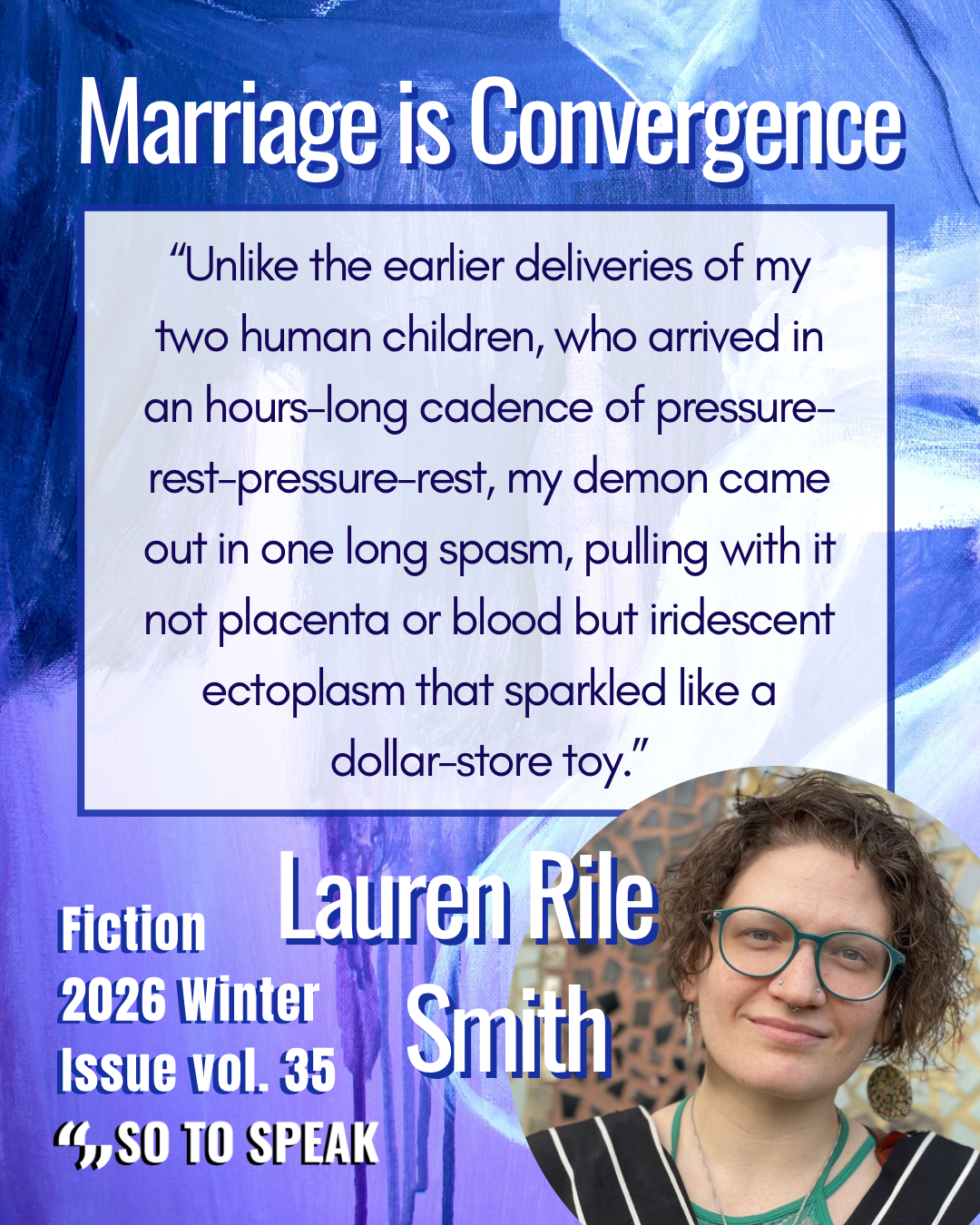
I birthed my own demon. That was hell. Unlike the earlier deliveries of my two human children, who arrived in an hourslong cadence of pressure-rest-pressure-rest, my demon came out in one long spasm, pulling with it not placenta or blood but iridescent ectoplasm that sparkled like a dollar-store toy. My body ached. The demon wriggled on my belly. It was wineberry-purple, eyes crusted shut, small enough to fit into two cupped hands.
So I held it. Walked out of the bathroom, thighs glitter-spotted and shaky. “Peter?” No answer, which meant nothing. He was in the bed, like always: rolled onto his side, jaw slack, staring into the eyes of his own midnight-blue demon. “Peter? I have to show you something.” He couldn't hear me. Downstairs the kids were still busy watching different episodes of The Powerpuff Girls, at top volume, on separate iPads at two ends of the house.
Our home was too full for another demon. I had to refuse it. Return to sender. But the sender was me, my own insides. I put the demon into the soft nothings of my underwear drawer, nestled in a satin-and-cotton cradle of granny panties, and left the drawer open.
#
Marriage is compromise. People say this. But that conjures up a tidy tit-for-tat scenario, like: “My husband wanted to paint the house bold colors, and I wanted neutral. So we split the difference and did white with red accents.” It’s true that in the early years we negotiated passionately over all sorts of choices that meant jack shit to me now. I could barely remember being the pregnant 28-year-old who argued for Montessori preschool versus Waldorf. I wanted early readers, not illiterate knitters.
It turned out that all the soft-spoken, big-earringed reading-specialist kindergarten teachers in the world couldn’t midwife the miracle of written language for a child whose brain made the letters dance backwards across the page. Until one Saturday morning when she was seven, waking me up to ask about the book on my nightstand. “Mom, what's ‘self-pleasure’?” Then she swallowed the entire Artemis Fowl series in a weekend. Just as with literal birth, all children pass through portals at different rates; once arrived, the speed with which they got there is irrelevant.
That may be true for adults too, whose arrival is harder to clearly mark. Marriage is a co-authored novel, a philosophical truce, between parties who can never fully speak to or for each other but have dedicated their lives to acting like it hard enough that it somehow also kind of happens. After 13 years my body felt like half of a couplet, incomplete without Peter’s. I still wanted him, wouldn’t prefer to rhyme with anyone else.
But whenever he was awake, his all-absorbing demon hovered weightlessly between my spot and his on the bed. Like a malevolent cockblocking body pillow, a wife-usurper no trick can budge. Except each night she transformed into a dense, dark-blue mist he inhaled as he fell asleep. His cheeks were fuller when the demon was inside him. It cured his sleep apnea somehow, so I slept more soundly, too. We wriggled together, a silent pantomime of closeness. The warm slide of our shins against each other was the safest part of my day.
#
When I checked back after my shower my demon had already doubled in size, the fuzz on its belly strawberry pink. Its little black eyes were open. As they focused on me, hunger gusted through me like a sudden wind. I put my hand into the drawer and let the demon ascend my forearm like a lizard. Its tiny claws tapped me, a silent request.
“I hear you,” I said, and descended to the kitchen. Our cupboards contained mostly ingredients: dried beans, canned tuna. But there was half a pound cake tucked behind the yogurt in the fridge. I ate standing, letting crumbs fall into the kitchen sink. We went through the whole bowl of stone fruit on the kitchen counter, then a box of rabbit-shaped cheddar crackers, two sleeves of stale gingersnaps, and several packets of seaweed snacks intended for the kids’ lunchboxes. I grabbed my car keys, hands still sticky with peach juice. “Going grocery shopping,” I announced to no one, and walked out through the garage.
In the store, we paced the aisles, distracted by each bouquet of colorful packaging. The need to eat flashed across my body, alternating skin-prickles with warning spells of nausea. I tore open the plastic skin over a dozen mini bagels and crammed one into my mouth. Discreetly, I thought. The demon wrapped its tail around my wrist.
#
Of course I wanted him to stop searching. I couldn’t believe there was anything real to find inside the big dark rings of his demon’s gaze. But for the two years since his layoff, it’d been Peter’s world. He would update me in the urgent, foggy tone of a sleep-talker already in transition to the next dream. “Now this lake has a deep center where the gravity reverses, but....” Wiped spit from the side of his mouth, eyes shifting, carried away by his own new thoughts.
The balloon of motherhood may expand to contain almost infinite responsibility. At each turn, I discovered how elastic I could be. I kept it together. I paid the utility bills, I renewed our health insurance, I took a conference call while cooking dinner, I got the kids to school and back, I made decisions by myself about what they were allowed to watch on TV and whether they were old enough for ear piercings. He got SSI disability payments, about one-third of his former salary, for his debilitating paranormal parasitosis: the official diagnosis. The science of demon possession was young, but of course there was already a whole system. It mattered what kind of demon you had. I shopped at the discount grocer, not Whole Foods. We got by.
If this were just a new job, sure. Pursue a Ph.D. in German philosophy like our neighbor who cornered me for 30 impenetrable minutes at a barbecue. We didn’t have to love or understand all the same things; marriage isn’t a mind-meld. But there was no room for me alongside his demon, the hero’s journey they pursued together into nothingness. When I gently broached this, stroking his neck to keep his attention, Peter said, “But I know that I… I’ll figure it out if I keep looking.”
I’d been on Zoloft since my junior year; this wasn’t my first rodeo. You don’t snap out of depression until you decide to stop seeking pointless answers. It doesn’t mean your quest for truth is over, but you can pause or reframe it. With the help of a professional. Don’t get stuck.
You don’t need to collaborate with someone to decide to leave them, either. But I did still want Peter. So I was stuck, too. Our mutual standstill was its own kind of consolation, a matching set of midlife loser trophies.
#
My teeth punctured the plum’s tart skin, let it play on my tongue. Dripping flesh slid down my throat. As soon as I took it in I wanted more, groped in the grocery bag with eyes closed. By feel I found a ripe tomato and raised it to my face to inhale. Grassy, like clean dirt. Taut and firm. Then bit it whole, as it sagged and squirted under my fingertips.
The demon nuzzled its face into my neck, purring. It loved my body, and it loved my desire for things outside my body, the metabolic magic trick of placing food into myself to transform not-me into more of me. Boundaries smashed, still hungry. We spiraled around each other, one long continuous note of craving.
By the time we’d pulled back into the driveway, trunk full of loot, the demon was as long as I was tall. Now it wrapped around me, shoulder to ankle with yards to spare, belly swollen as mine was empty, fur patterned with burgundy swirls. The end of its tail lolled near the refrigerator, playfully tapping the floor.
Another surge of need: salt. I grabbed the shaker from the kitchen table and tossed it back like a shot of liquor. Then a handful of cookies, another tomato, the leg from a rotisserie chicken whose oily scent flooded my mouth with saliva. Almost too hot to eat, its flesh parted effortlessly from the bone. Each swooning bite was a climax that faded too soon, replaced by pickled irritation. If I put it off for even minutes, a foggy sadness climbed up my throat.
“Are you a fatigue demon?” I whispered into its embrace. Its pulse thudded on my sternum.
I fortified myself to travel up the stairs with a family-size bag of chips, kefir smoothie, box of shelf-stable beef stock, and bag of apples which slowed me down until I stopped nibbling around the cores to chomp through them, seeds and all. By the time I finally made the upstairs landing, the kids’ dueling iPads had turned into Minecraft theme music. We had at least an hour, then.
I chugged the smoothie and tossed it down the stairs. Staggering to our bed, I laid the heavy coils of my demon, floppy and warm, wine-red and rose-pink, on the mattress next to Peter’s. My demon sunk into the duvet, eyes locked on me, still holding my elbow with two of its finely-haired hindfeet. Peter’s demon swiveled her depthless gaze down to capture my demon: its big black eyes, sweet alligator grin, little yellow horn-bumps spiking from its forehead like a young deer’s. Her body blurred, a shudder rippling from head to tail, and began to expand into the mist Peter inhaled every evening.
With a sudden lasso-like whip of its tail, my demon caught her around the middle, at her most solid point, and drove her towards its mouth, which gaped open like a pelican’s. Our room felt darker and smaller, the plunge of barometric pressure right before lightning. Peter’s demon broke into cloudy eddies, shaped by the wind of its inhale into a whirlpool, which stretched and poured down my demon’s throat.
Within moments she was swallowed, along with the part of my demon that held her. The slenderest length of tail flew in instantly, but its jaw caught on the first set of hind legs. They wavered in the inhalation, perched awkwardly on its teeth, the demon grimacing around its own hips. Then, with another tug of the vacuum pressure from deep inside the demon, the legs popped through.
By now my demon’s body was so long that it took several horrible beats to travel into itself. The loops of its body shuffled along the mattress, tight and elastic by turns, flushed skin and sleek fur elapsing into the void of its mouth. With a quiet thunderclap its head inverted, like a glove being turned inside-out. Crisp flash of shiny teeth and gleaming eyes and ridged, puffy palate and gums. Crumpled in on itself, and popped out of existence.
I rested my head on the bedspread and watched it happen almost without curiosity, feeling breath move slowly in and out of my lungs. The exhaustion of hunger was a drain without a stopper. And then it was over, my lungs able to take an entire breath.
Peter sat up from the groove he'd worn in the mattress, cautiously stretching his arms. The room smelled like ripe tomato. I was neither full nor hungry, a balloon the same weight as the air.
“I guess they were opposite enough to be the same kind of demon,” I said, an academic footnote to an analysis that didn’t need to get written. Surfeit and famine are flipsides. We did still rhyme, after all.
Peter and I blinked at each other, shy like strangers. I reached over and touched his pinky finger with mine.
He had to clear his throat twice, voice a disused croak. “Want to go see what's in the kitchen?”
Lauren Rile Smith is a Philadelphia-based queer disabled writer, editor, and trapeze artist who finds electric connection with bodies in motion and words on paper. Her writing has appeared in publications including the Philadelphia Inquirer, Stirring, Skanky Possum, Xconnect, and Vocabula Review. She has served as Founding Editor at Cleaver Magazine and Assistant Editor of the American Poetry Review, works as the Rare Materials Specialist at the University of Pennsylvania Libraries, and founded the contemporary circus company Tangle Movement Arts. More: https://rilesmith.neocities.org/